
Nitrogen-containing heterocycles constitute an essential class of structural motifs in medicinal chemistry and drug development. In particular, imidazole derivatives have gained sustained interest due to their favorable physicochemical properties and biological relevance. The imidazole ring is present in key endogenous molecules, enabling diverse noncovalent interactions with biological targets. As a consequence, imidazole-based compounds exhibit a broad range of pharmacological activities, including analgesic, antihypertensive, anticancer, antiviral, antitubercular, anti-inflammatory, and antidepressant effects [1-3]. 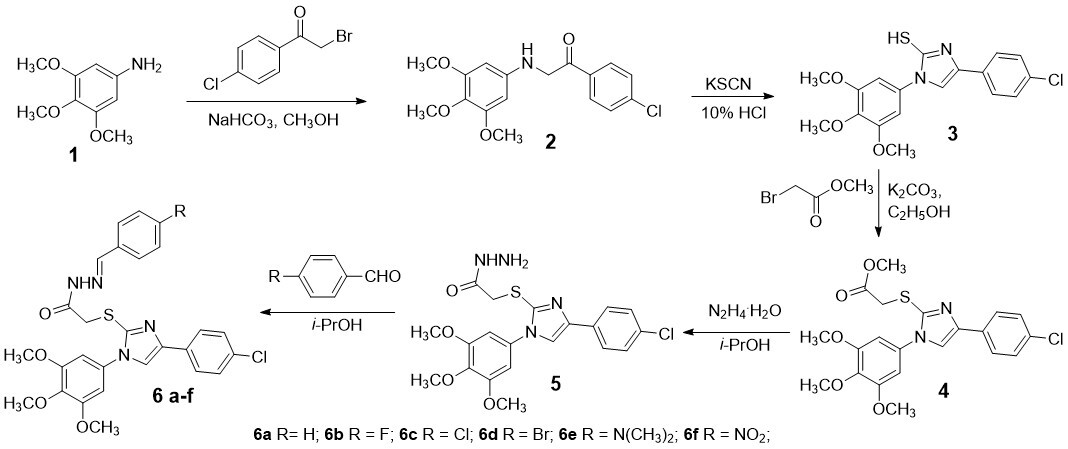
In this study, 3,4,5-trimethoxyaniline (1) upon reaction with 2-bromo-4′-chloroacetophenone in methanol at room temperature for 2h formed the target 1-(4-chlorophenyl)-2-((3,4,5-trimethoxyphenyl)amino)ethan-1-one (2). To obtain compound 3, This α-amino ketone 2 reacted with potassium thiocyanate in diluted HCI. The reactions afforded imidazole-2-thione 3. We found that the reaction of compound 3 with methyl bromoacetate in ethanol, in the presence of potassium carbonate, occurred uniquely to give the product of S-alkylation – methyl 2-((4-(4-chlorophenyl)-1-(3,4,5-trimethoxyphenyl)-1H-imidazol-2-yl)thio)acetate (4). The obtained methyl ester 4 was transformed into hydrazide 5 using hydrazine monohydrate in 2-propanol (Fig. 1). Condensation of compound 5 with aromatic aldehydes in propan-2-ol led to the formation of N’-benzylidene hydrazides 6a−f. The structures of the obtained compounds were confirmed by the data of the \(^{1}\)H, \(^{13}\)C NMR and FT-IR spectroscopy and elemental analysis.