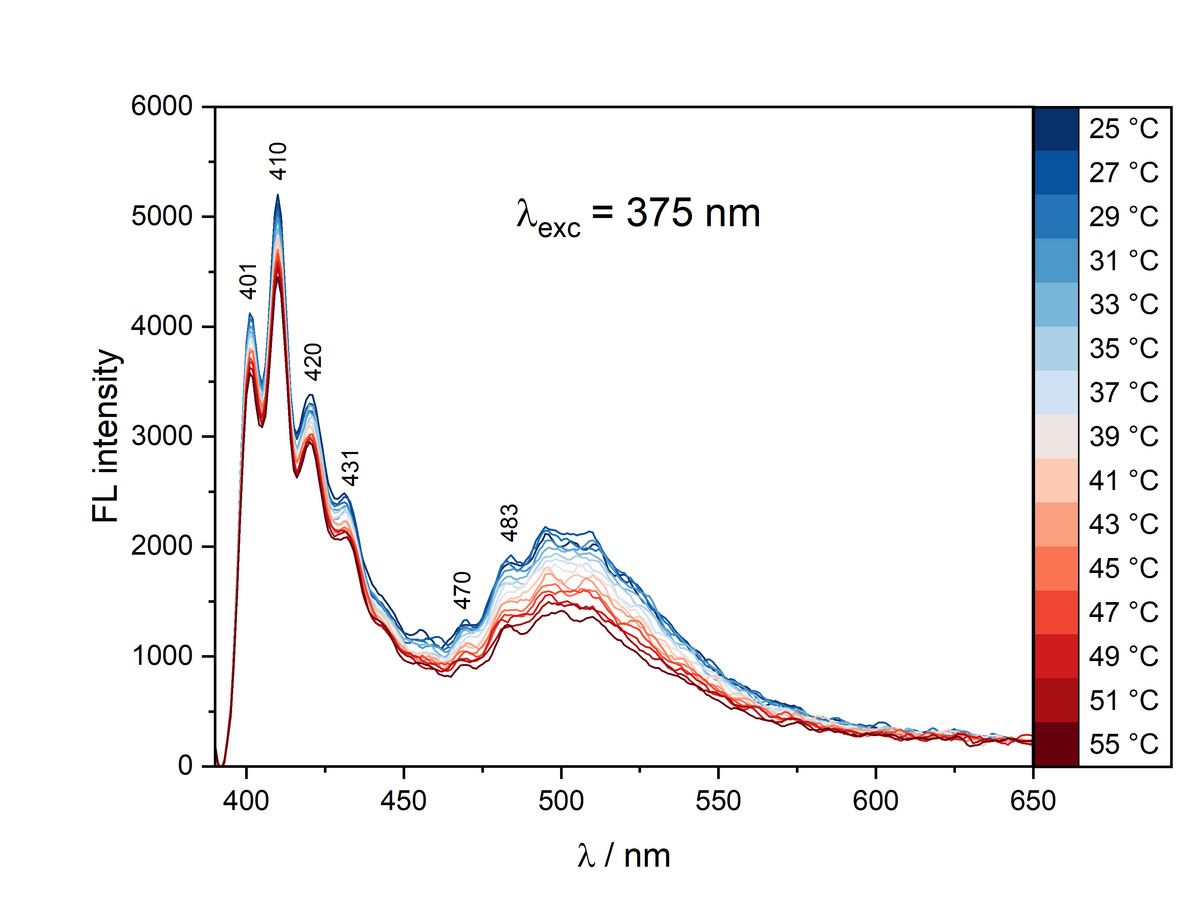
Diamond‘s biological compatibility and easy functionalization make this material promising in quantum biosensing [1]. NV, SiV and GeV color centers can be useful for optical sensing of magnetic fields, electric fields and temperature [2-4]. In this work, the diamond plate and diamond microneedles samples fabricated with chemical vapor deposition (CVD) method were investigated. Steady-state and time-resolved fluorescence spectroscopy experiments using 375 nm excitation were conducted in the temperature range from 298 K to 328 K. Fluorescence spectra of both diamond samples show phonon sidebands that reveal electron-phonon interactions of 389 nm color center. In case of diamond microneedles, a zero phonon line at 470 nm with a phonon sideband was observed. Color centers with zero phonon lines at 389 nm and 468 nm could be nitrogen-related [5]. Fluorescence kinetics measured at phonon sidebands can be described with biexponential decay. Measured fluorescence intensity decreases with increasing temperature. In case of diamond microneedles this dependence is linear. Fluorescence lifetimes at 410 nm do not show a clear dependence on temperature, while lifetimes at 500 nm show a linear decrease with increasing temperature.
The temperature-dependent luminescence behavior of 389 nm and 468 nm color centers in diamond was investigated and non-Arrhenius type behavior was identified. Linear dependence of fluorescence intensities and lifetimes could be useful in optical thermometry, since the device calibration is easier and complex data processing is not needed in case of a linear response.