ENHANCING RISC IN NARROWBAND BLUE MR-TADF EMITTERS
Giedrius Puidokas1, Lukas Deltuvytis1, Gediminas Kreiza1, Karolis Kazlauskas1
1 Vilnius University, Faculty of Physics, Institute of Photonics and Nanotechnology, Lithuania
OLEDs are widely used in displays due to their high contrast, wide viewing angles, and compatibility with flexible substrates. However, the development of efficient, long-lived blue OLEDs remains a critical bottleneck. Device degradation is closely linked to long-lived triplet excitons and their interactions (e.g., triplet–triplet and triplet–polaron annihilation), which can generate high energy excited states that may induce molecular decomposition [1].
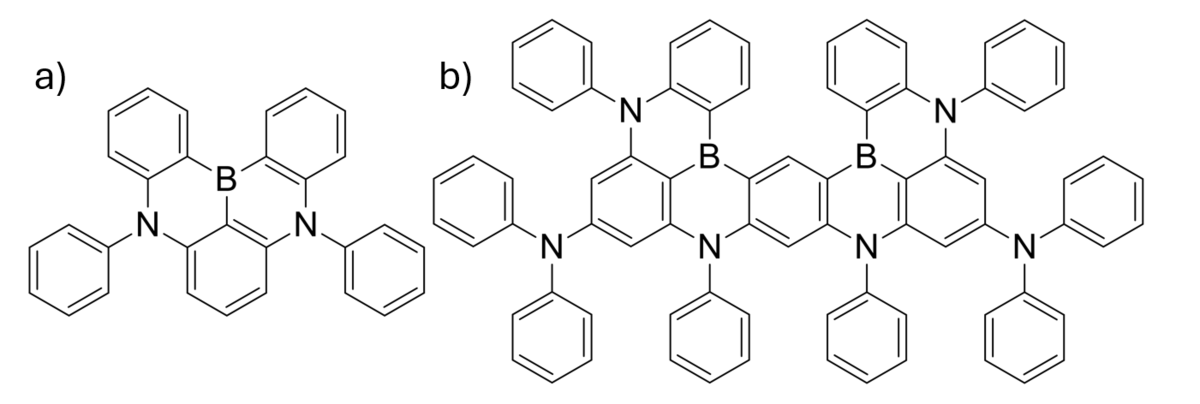
This work examines structural modifications of two multi-resonant thermally activated delayed fluorescence (MR-TADF) emitters, DABNA [2] and ν-DABNA [3] (Fig. 1). The derivatives are designed to balance high photoluminescence quantum yield (PLQY), efficient triplet harvesting via reverse intersystem crossing (RISC), and high color purity. Absorption and emission spectra, PLQY, and time-resolved photoluminescence are characterized in solution and thin films. Selected derivatives reach PLQY >80% and RISC rates up to 10⁶ s⁻¹ while maintaining narrowband emission (FWHM ≤20 nm).
Fig. 1. (a) DABNA and (b) ν-DABNA
Across the series, structural variations are assessed for their impact on emission spectrum, PLQY, and excited state dynamics, with π-extension, in particular, associated with narrower, red-shifted emission and enhanced RISC. At the same time, increased π-extension can exacerbate aggregation and concentration quenching in solid films, which are common challenges for MR-TADF emitters [1]. As a next step, selected derivatives could be used either as standalone emitters or as sensitizers in hyperfluorescent OLED architectures.
[1] X. Wu et al., “Comprehensive Review on the Structural Diversity and Versatility of Multi-Resonance Fluorescence Emitters: Advance, Challenges, and Prospects toward OLEDs,” Chemical Reviews, vol. 125, no. 14, pp. 6685–6752, May 2025, doi: 10.1021/acs.chemrev.5c00021.
[2] T. Hatakeyama et al., “Ultrapure blue thermally activated delayed fluorescence molecules: efficient HOMO–LUMO separation by the multiple resonance effect,” Advanced Materials, vol. 28, no. 14, pp. 2777–2781, Feb. 2016, doi: 10.1002/adma.201505491.
[3] Y. Kondo et al., “Narrowband deep-blue organic light-emitting diode featuring an organoboron-based emitter,” Nature Photonics, vol. 13, no. 10, pp. 678–682, Jul. 2019, doi: 10.1038/s41566-019-0476-5.