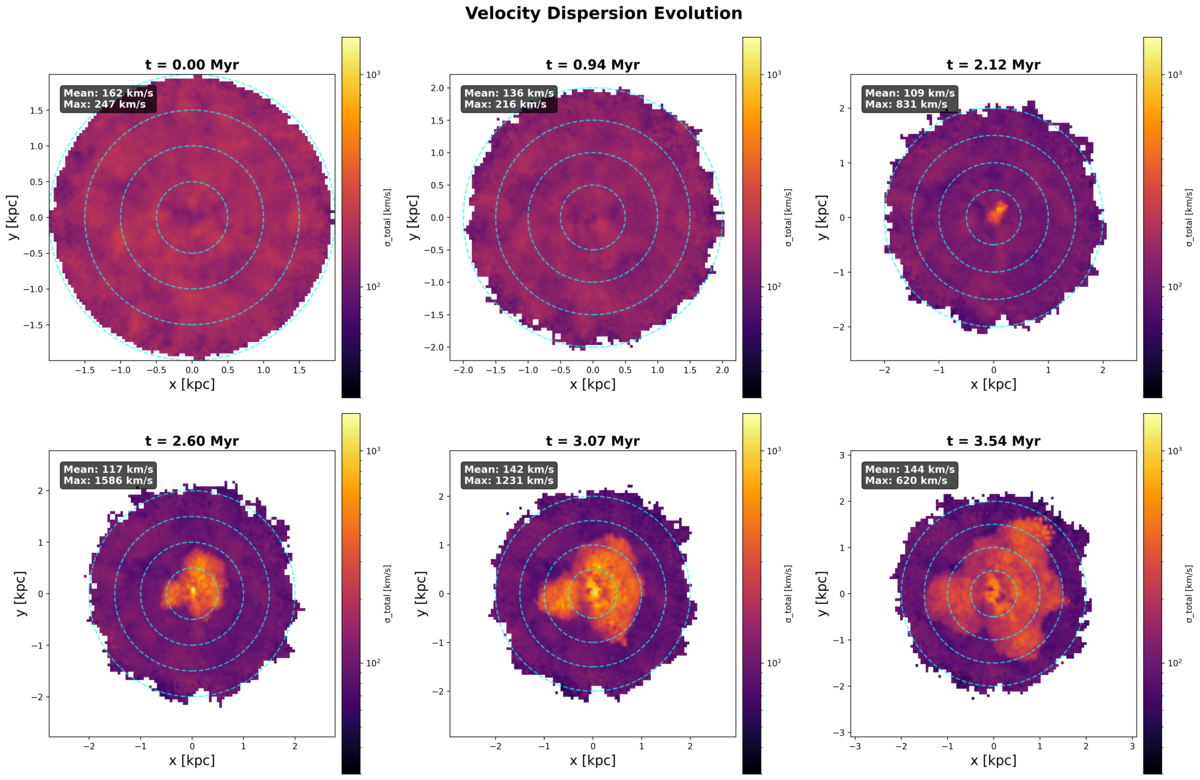
Supermassive black holes at galaxy centers power Active Galactic Nuclei (AGN), releasing huge amounts of energy into the interstellar medium (ISM). AGN-driven outflows regulate star formation and shape galaxy evolution [1, 2]. Understanding outflow propagation through turbulent environments is essential for interpreting observations and validating AGN feedback models. Direct observations remain limited because of long evolutionary timescales, requiring numerical simulations.
This work investigates the kinematics of AGN-driven outflows in a turbulent interstellar medium through hydrodynamic simulations using the Smoothed Particle Hydrodynamics (SPH) method with the Gadget - 3 code [3]. Analysis was conducted using Python - based tools, which involved calculating radial velocities to identify outflowing gas, decomposing energy budgets, constructing phase diagrams, and locating shock fronts.
The results show a transition from kinetic to thermal energy dominance after AGN activation, confirming energy-driven outflow dynamics. The velocity dispersion increases from background (\(\sim\)50 - 70 km s\(^{-1}\)) to 200 - 300 km s\(^{-1}\) in shocks, with peaks at \(\sim\)1500 km s\(^{-1}\) in dense clump collisions. The outflow develops a multi-phase structure (10\(^{4} - 10^{8}\) K), and non-spherical filamentary morphology shaped by turbulence.
These findings agree with theoretical predictions, demonstrating that SPH simulations capture essential AGN feedback physics in turbulent galactic environments [4].