Sub-terahertz (sub-THz) and terahertz (THz) frequency range, located between infrared and microwave frequency ranges, is becoming one of the main paths towards developing next generation devices for the huge amount of various applications [1]. Including imaging‑related approaches as well as high-frequency communication systems, like 5G and 6G [2, 3]. Considering the data transmission, efficient beam-shaping is required to compensate the comparably high atmospheric absorption, which limits signal’s path distance and lowers its intensity, especially in humid conditions. Metasurfaces, being considered as a viable alternative to the refraction-based beam-shaping solutions, experience fabrication difficulties at high-THz range due to the decreasing size of the metasurface--comprising metaatoms. In this work, higher modes of metasurfaces were investigated to evaluate their empolyment possibility in beam-shapping structures to achieve high intensity beam propagation signal and enhance directivity properties.
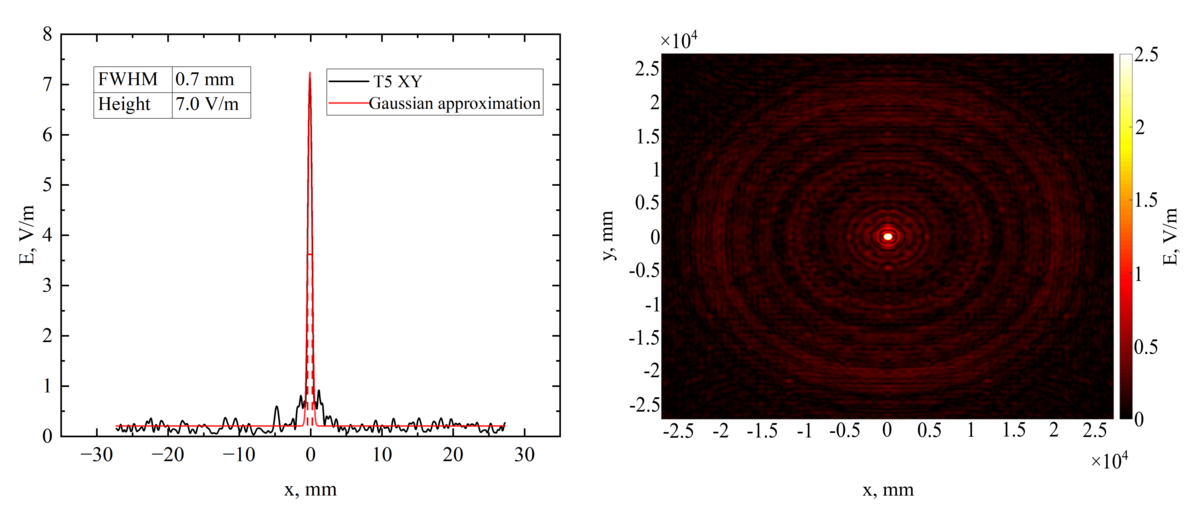
Employing complementary split-ring resonator (CSRR) metasurfaces six different metalense designs (T1 - T6) of varying geometrical parameters were investigated. Programming language’s ”Python” codes were written for C-shaped metaatom geometry-dependant resonance frequency analysis. Created designs were simulated using the Time Domain mode of the CST Studio Suite software and revealed focusing at 600 GHz. The particular frequency was selected as frequency of interest, as the resonator metaatom dimensions for the frequency are close to the limit of currently employed laser cutting system, but still large enough to ensure repeatability. Simulation results of the best-performing structures revealed full width at half maximum (FWHM) values of FWHM\(_{K1}\) = 0.7 mm and FWHM\(_{K2}\) = 0.6 mm, respectively and depth of focus values of DOF\(_{K1}\) = 2.7 mm and DOF\(_{K2}\) = 2.0 mm, respectively. Considering the wavelength of 0.5 mm, roughly equivalent to 1 full wavelength FWHM is considered close to optimal and represents the cases recorded during observation of the metalenses operating in the first order resonance conditions [4].
The exploitation of higher-order resonances of metaatoms in metasurface-based beam-shaping elements represents a promising approach for applications in the sub‑THz and THz frequency ranges by demonstrating a near-wavelength-limited focusing performance. Employment of higher-order modes of the metaatoms is expected to extend the applicable frequency range of the laser-cut metasurface to at least several terahertz.