Sustainable groundwater management requires integrated evaluation of groundwater quantity and quality under changing climatic and anthropogenic pressures. This study combines satellite gravimetry, national monitoring data, and machine learning methods to investigate relationships between groundwater level (GWL) dynamics and hydrochemical variability across Lithuania. Groundwater level and hydrochemical data (2002 - 2024) were obtained from the Lithuanian Geological Survey and merged with terrestrial water storage anomalies derived from NASA’s GRACE mission.
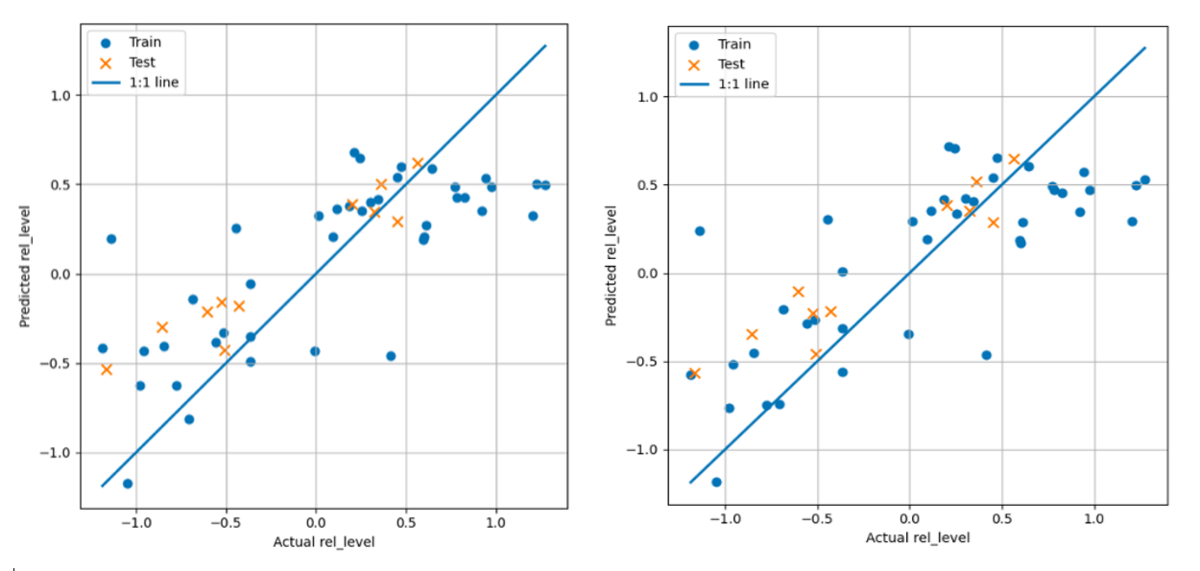
Machine learning models were applied to assess relationships between groundwater level fluctuations and key hydrochemical variables. The input chemical parameters used for modelling included chloride, calcium, and sulphate concentrations. The analysis aimed to identify three dominant chemical parameters showing the strongest correlation with groundwater level dynamics. Regularized linear models (LASSO and Ridge) were used to predict relative groundwater level variations at Well 283 (Fig 1). Both models show a moderate to strong positive correlation between observed and predicted levels (r ≈ 0.82 - 0.83), with test performance of R2 ≈ 0.68 - 0.69. While cross - validated R2 values were lower (≈ 0.33 - 0.35), indicating variability across samples, the results demonstrate that linear relationships explain a substantial fraction of short-term groundwater variability, with LASSO providing slightly improved generalization and model simplicity.