
Despite constantly increasing demand for small, powerful and cost-efficient THz radiation sources, there still is a significant lack of such emitters operating at room temperature. Invention of quantum semiconductor superlattices by Esaki and Tsu [1], allows employing them as a platform for high-frequency parametric generation or amplification. Although the theoretical explanation of these processes was noticeably developed throughout almost 50 years, there was no experimental evidence, leading to the unconformity of theoretical assumptions [2, 3].
In this work, experimental evidence of parametric gain in GaAs/AlGaAs superlattice was observed for the first time. It resulted in generation of harmonics, sub-harmonics and fractional frequencies corresponding to the multiphoton generation process described by
$$ \omega_1 \pm \omega_2 = n_{\pm}\omega_0; \qquad 2\omega_1 = n_0\omega_0 \tag{1} $$equations [4, 5]. As each of the spectral line in the recorded dataset can be assigned to participation in several multiphoton processes (with different $n_{\pm}$) simultaneously, it shows the need to upgrade the existing theoretical model which does not take into account simultaneous occurrence of several multiphoton processes. This argument was also confirmed by the discrepancy between the experimental power profile and the theoretical gain profiles.
Matching of superpositioned theoretical multi-photon gain profile and the experimental emission power dependency on static field strength was performed for one of the frequency datasets (Fig.1). Such superposition becomes possible due to existance of profile peculiarities, allowing to express and manipulate superpositioned gain profile using the equation
$$ \left(\frac{\mu}{\mu_0}\right)_{total} = \sum_{n=1,2,3\dots} C_n \cdot \frac{\mu_n}{\mu_0} , \tag{2} $$where $C_n$ is the weight coefficient. The fit performed for $n$=1,2,3 processes resulted in pecularity-matching gain profile. Inverse weight coefficient proportionality to $n$ also meets theoretical considerations showing that processes with smaller $n$ values have bigger influence on the final gain profile.
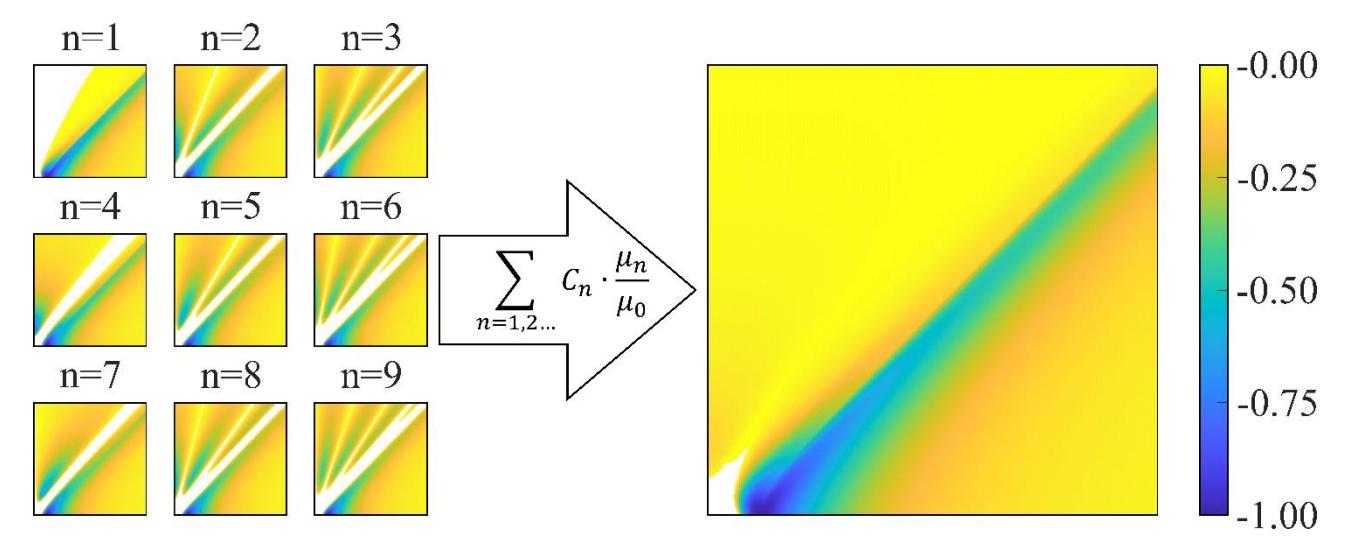
Such upgrade of the theoretical model allows to confirm obtained experimental results for the dissipative parametric high-frequency generation/amplification in quantum semiconductor superlattices.