Anelloviruses (AVs) are relatively recently discovered small, highly abundant, eukaryotic viruses. Family Anelloviridae consists of 14 genera (namely from Alphatorquevirus to Zetatorquevirus) and 76 species according to the 2019 release of Taxonomy by International Committee on Taxonomy of Viruses (ICTV), and is known to infect various vertebrate hosts, including humans. The first member of this diverse family, Torque Teno Virus (TTV), was identified in 1997, in an individual with a post-transfusion nonviral hepatitis, although there no disease association [1]. Other human anelloviruses include Torque Teno Midi Virus (TTMDV) and Torque Teno Mini Virus (TTMV), which differ from TTV in the size of genome. In human population, individuals become infected during the first year of life, which suggests a vertical transmission route of AVs.
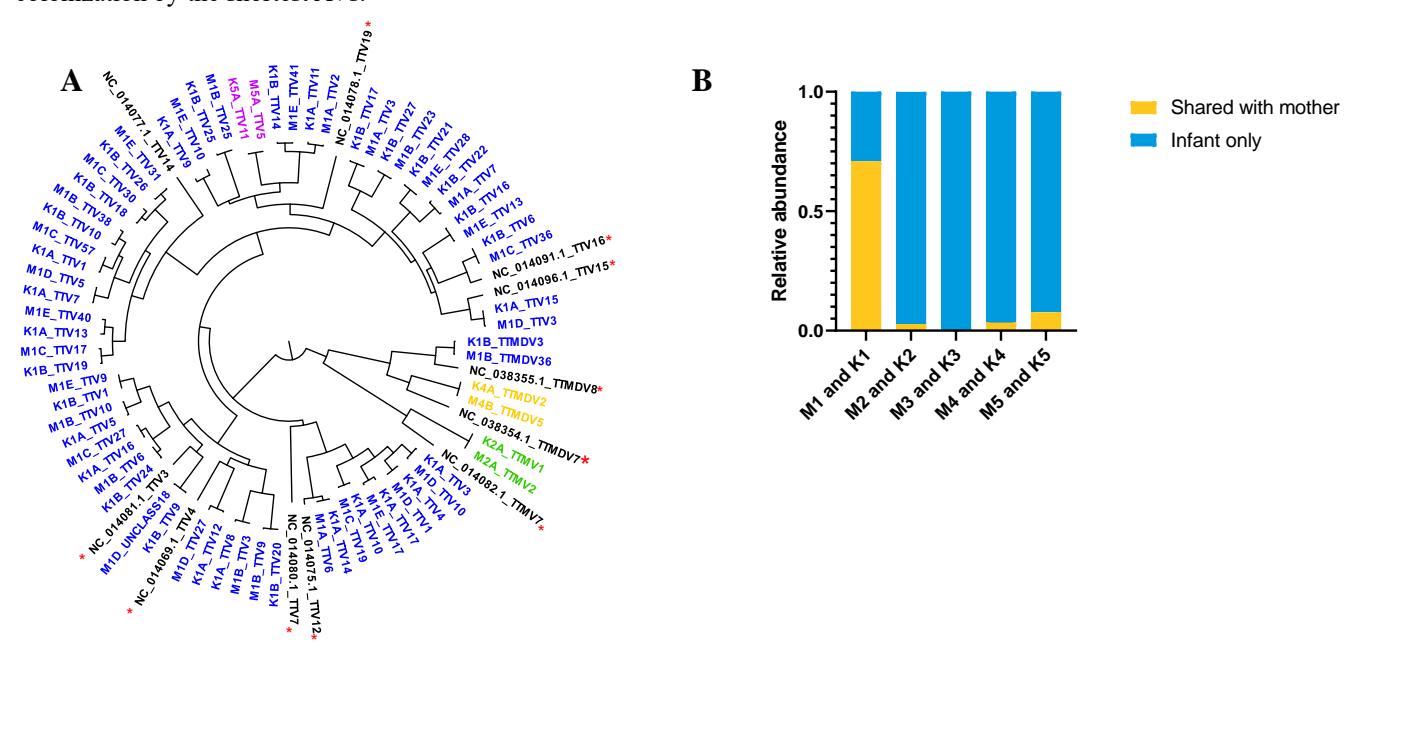
In this work we aimed to investigate a possible mother to child transmission of three human-infecting AV genera: TTV, TTMV and TTMDV, in longitudinally collected serum samples of five HIV-1 positive mothers and their infants. Using Illumina next generation sequencing (NGS) data, we identified 449 unique AV genomes across the analyzed five pairs. The level of AV richness was different in each subject, which emphasized that anellovirus virome (anellome) is person-specific. Based on the analysis of longitudinally collected samples we observed that children were mainly infected with TTMVs, while most of the genomes found in mothers were TTV. Most importantly, we identified 35 genomes which were shared between mother and her child (Figure 1). The genomes were identical or nearly identical, showing ≥91% whole genome sequence identity on the nucleic acid level. We could confirm the NGS data by specific qPCR for three selected shared genomes. Additionally, a different set of children samples was analyzed to evaluate which AV genus is the most prevalent in the first months of life. We hypothesized that TTMV and TTMDV could be the early-infecting human AVs and performed a second analysis using 25 cross sectional serum samples obtained at ages between 0 and 65 months. We show here for the first time that TTMV and TTMDV are the first AVs colonizing a child. In conclusion, our in-depth analysis supports a possible transmission of AVs from mother to child via air or the oral-fecal route, with early colonization by the shortest AVs.