Photonic crystal fibers (PCFs) are different from conventional optical fibers, because PCFs have a periodic microstructure region inside where light is propagating. Solid core PCFs are perfect nonlinear media, in which nonlinear processes can occur due third-order nonlinearity, which results in the generation of the supercontinuum [1]. It is one of the most important and widely analyzed nonlinear optics phenomena, in which pump pulse spectrum broadens hundreds or thousands of times [2]. This phenomena has many important applications, in areas such as spectroscopy, frequency metrology, and optical coherence tomography [3]. Although a wide variety of supercontinuum generation in PCFs research has been done, research in which the length of a short PCF is changed in small steps has not been performed.
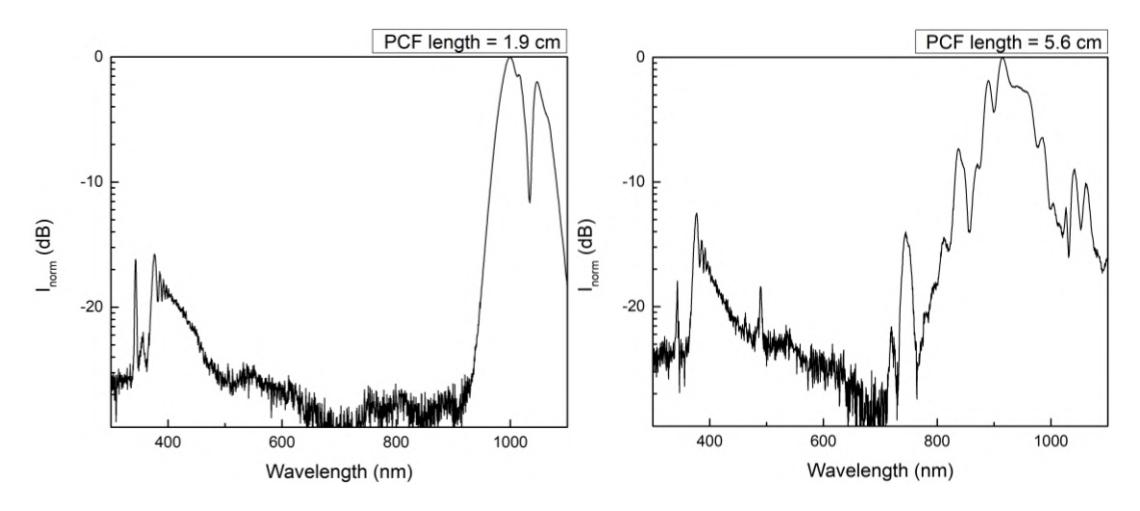
In this study, we present the experimental and theoretical model results of femtosecond supercontinuum generation in different length photonic crystal fiber. The pump source for supercontinuum generation was an Yb:KGW “Flint” oscillator generating 1028 nm wavelength with a repetition rate of 75.2 MHz and 110 fs duration pulses. For supercontinuum generation, we used a highly nonlinear polarization-maintaining solid-core PCF in which the core diameter and the pitch were 4.8 μm and 3.25 μm, respectively. The zero-dispersion wavelength of this PCF, was at 1087.4 nm ±10 nm (very similar for both polarization modes). During the experiment, we performed the spectra measurements at PCF output by changing average power of the pump pulses.
Experiment results show, that by changing the length of PCF we observed different spectral features in spectra at PCF output. When using shortest PCF lengths the extreme spectrum broadening was not visible, but we observed three separate nonlinear processes: self-phase modulation of the pump pulse; generation of the third harmonic (TH) (342.7 nm) and partially coherent UV-VIS light generation within 375 - 500 nm wavelength range. At longer PCF length spectra we observed new spectral components. In this case, more nonlinear processes occur which results in supercontinuum generation. UV-VIS light is visible in all cases: this can be explained by the formation of self-trapped excitons (STE), which are trapped by their interaction with lattice distortions. Free excitons are created along the PCF due to multi-photon absorption, and then decay due to STE by emitting UV-VIS light [4]. Numerical simulation was also performed and had a good agreement with experiment results.