
Metal additive manufacturing has been at the top of attention for the past few decades, and it offers a variety of technologies for three-dimensional object production. One of such technologies, allowing large-sized object production, is laser-assisted metal deposition, the limits of which are determined by the capabilities of the positioning system. The already existing nozzles have either a relatively low build rate or a poor resolution [1,2].
The goal of this work is to develop a centered particle beam at high velocity for the laser-assisted new nozzle with metal additive manufacturing technologies. Scientific challenges are addressed at the fluid dynamics of two nozzles based on the de Laval geometry with Witoszynski and Bicubic curves [3,4] of convergence zone, the particle-substrate contact and tracking of the thermodynamic state during contact.
De Laval nozzles consist of four parts, namely the straight part, the convergent part, the throat and the spread part (Figure 1). The flow of compressed gas has a high degree of turbulence, which is not conducive to gas shrinkage in the convergent section of the nozzle. Therefore, a straight section is established in front of the convergent part of the nozzle to ensure an even distribution of the flow inlet velocity.
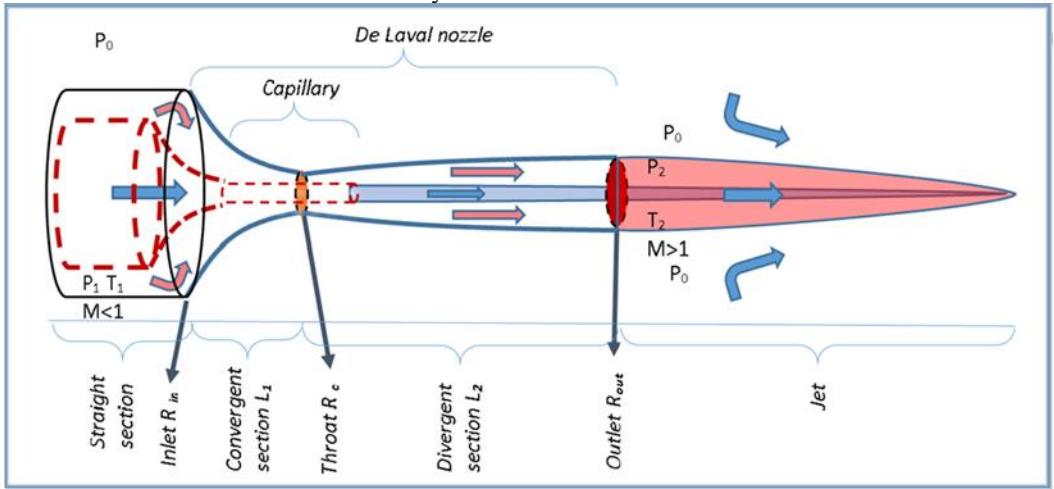
Fluid dynamics investigation results showed average flow velocity in Bicubic outlet curve nozzle is around 615 m/s and in Witoszynski - 435 m/s. Studies of particle beam formation for the Bicubic curve geometry revealed that small particles have the highest velocity and the lowest total force at the nozzle outlet. Fine particles have a shorter response time, and therefore a smaller dispersion area.
The elasto-plastic particle-surface contact showed that particles of diameter limited up to 3 μm are able to reach experimentally obtained critical velocity without additional heating. Wherein, for particle sizes above 10 μm additional heating is needed for deposition. The maximum coefficient of restitution is achieved with a particle size of 30 μm, smaller particles are characterized by the values of coefficient of restitution which are lower due to a relatively high velocity. Particles larger than 30 μm are scalable, characterized by a small change in velocity and a rise in temperature as their mass in-creases.
The numerical simulation results showed that the suggested a centered particle beam at high velocity based on Bicubic curve geometry of metal deposition nozzle has potential abilities of effective particle deposition.