
Irradiation of inorganic materials: dielectrics, semiconductors and metals with multiple femtosecond laser pulses at high repetition rate induces structural modifications resulting in formation of self-organized laser-induced periodic surface structures (LIPSS) [1]. According to the periodicity $\Lambda$ and morphology, LIPSS are classified into three types: low-spatial frequency (LSFL) with $\Lambda = \lambda/n_0$ [2] ($n_0$ is a refractive index of material), high-spatial frequency (HSFL) with $\Lambda = \lambda/2n_0$ [3] and wavelength-independent periodic annular surface structures (LIPASS) [4]. Many studies of LIPSS predict the dependence of its surface spatial characteristics on various experimental parameters such as number of pulses and irradiation wavelength, in particular. The latter experiments were performed mostly by using fundamental wavelengths of standard lasers and its harmonics, so its not enough to fully establish the LIPSS properties in the short-wave infrared range. Therefore there are still unanswered questions how the periodicity and morphology changes within this spectral range under irradiation of multiple femtosecond pulses. In this work we present the experimental study of LIPSS morphology and its periodicity evolution at high repetition rate with broadly tunable (in the $1 - 3~\mu m$ range) femtosecond laser pulses.
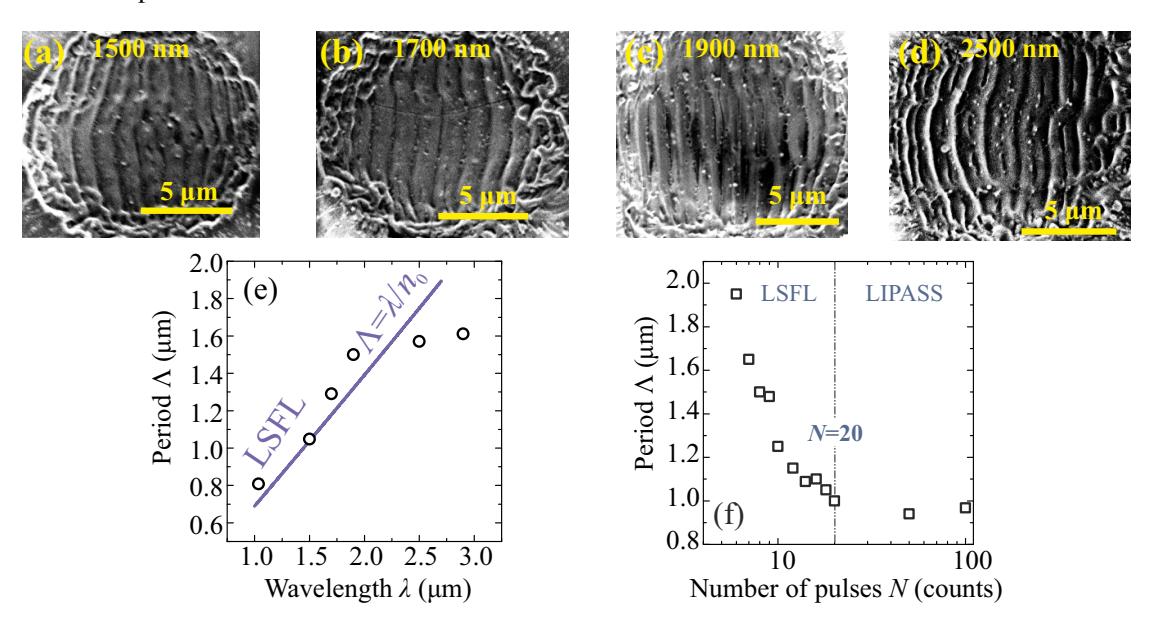
The experiments were performed using a commercial optical parametric amplifier (Orpheus, Light Conversion Ltd), pumped by Yb:KGW laser pulses, where the pulse duration and repetition rate were 180 fs and 10 kHz, respectively. The main results are summarized in Fig. 1. Fig. 1. (a)–(d) represent SEM images of LSFL in fused silica, produced with different irradiation wavelengths pulses and Fig. 1. (e)–(f) show LSFL period evolution with increasing inscription wavelength and number of pulses. Experimental results revealed an increase of LSFL period with increasing the inscription laser wavelength (Fig. 1 (e)), which was also obtained previously for HSFL [5]. In this way, the results indicates the same dependence of period on wavelength for both structures despite different formation mechanisms. In addition, the period values, retrieved from 2D Fourier transform, are very close to $\lambda/n_0$, therefore the modifications can be assigned to LSFL. Interestingly, we observed that short exposure to laser pulses at 1900 nm (Fig. 1. (f)) results in a significant decrease of the period. Such a result is reliable due to decrease of radiation peak fluence caused by surface ablation and formation of a crater. After 20 laser pulses, there are no significant changes of LIPSS period due to LIPASS formation, whose periodicity is not sensitive for ablation effect.