
Disposal of sludge produced from municipal wastewaters is an increasingly significant worldwide environmental problem. The materials used to separate the sludge often contaminate the sludge and make its further use more difficult. Coagulation/flocculation has been confirmed as an effective method and applied widely in water and wastewater treatment plants [1]. However, when using large amounts of inorganic coagulants some metals can remain in the treated water, e.g., aluminum, which can cause Alzheimer's disease [2]. Furthermore, synthetic organic flocculants are not biodegradable or degrade slowly, resulting in the formation of toxic degradation products that can cause carcinogenic effects when ingested. For more than half a century, the scientists have been looking for ways to replace synthetic flocculants with biodegradable polymer derivatives that are obtained from renewable resources. Modified starch flocculants could be a suitable alternative to fully or partially replacing synthetic ones. Increasingly, researchers are studying dual systems based on starch derivative flocculants, thus reducing sewage sludge contamination, and improving its continued use as fertilizer and biofuel [3].
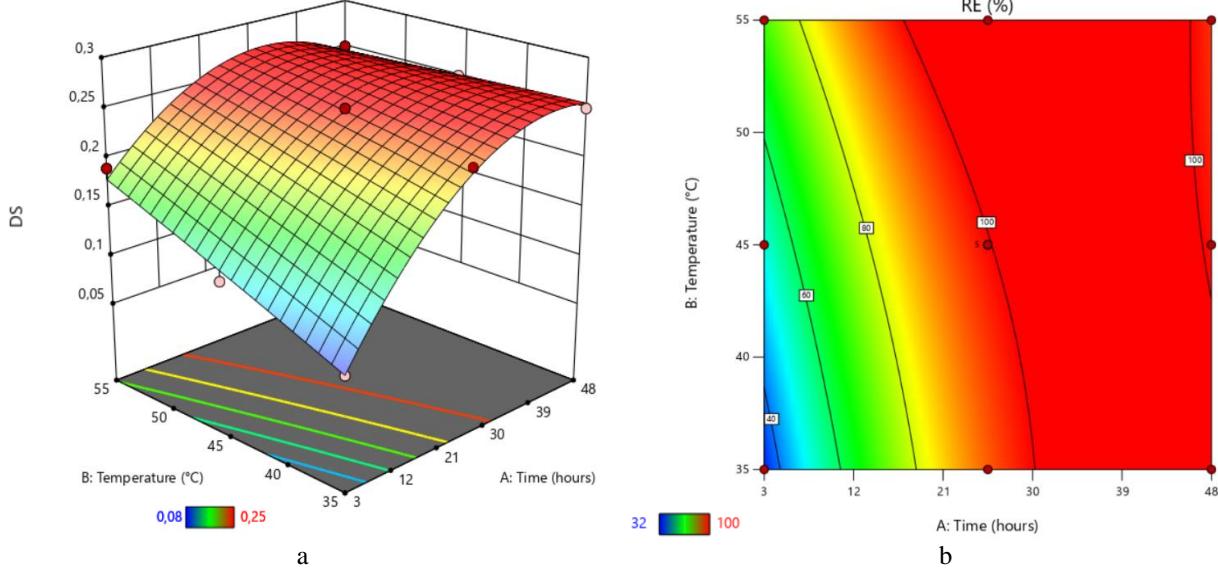
The aim of this study was to obtain cationic starches (CS) using CaO in cationization reaction and to evaluate the biodegradability and flocculation properties of CS in sewage sludge separation. CS were obtained by etherification of native potato starch with 3-chloro-2-hydroxypropyl trimethylammonium chloride using NaOH and CaO. The optimization of synthesis conditions to obtain CS derivatives with the best flocculation properties in the model system was conducted with the assistance of the Design Expert 13 software. Analysis of variance (ANOVA) was used in the analysis of the output data. The dependencies of the reaction efficiency (RE) and the degree of substitution (DS) on the reaction temperature and time were evaluated (Fig.1).
Flocculants are used to increase sludge dewatering efficiency. The interaction of flocculant and sludge results in clusters of sludge particles and formation of flakes. Moreover, the dose of flocculant significantly influences the content of dry solids in dewatered sludge. CS derivatives had flocculation properties similar to synthetic flocculants in the separation of sewage sludge as it was revealed by jar test. However, in sedimentation and filtration efficiency studies, dual systems with an anionic synthetic flocculant were used to achieve high efficiency. The sedimentation rate using synthetic flocculant was 148 a.u., meanwhile CS in combination with an anionic flocculant yielded sedimentation rate of 114 a.u.
It was revealed that biodegradable CS derivatives synthesized using CaO can partially replace the synthetic non-biodegradable flocculants, thereby reducing sewage sludge contamination, but they are not inferior to synthetic ones in terms of their efficiency.