Barium titanate-based materials has very attractive properties such as high dielectric constant, low dielectric loss and ferroelectric behavior. It is an essential electroceramic that is being used in multilayer capacitors, thermistors, and electro-optic devices [1],[2],[3]. Lead free barium zirconate and barium calcium titanate are getting more attention because it is environmentally friendly and pertains high dielectric permittivity while the ferroelectric phase transitions are suppressed. This onsets a relaxor behavior that is observed below room temperature. Some compositions are very attractive for applications because it has frequency independent dielectric permittivity at least up to 300 MHz.
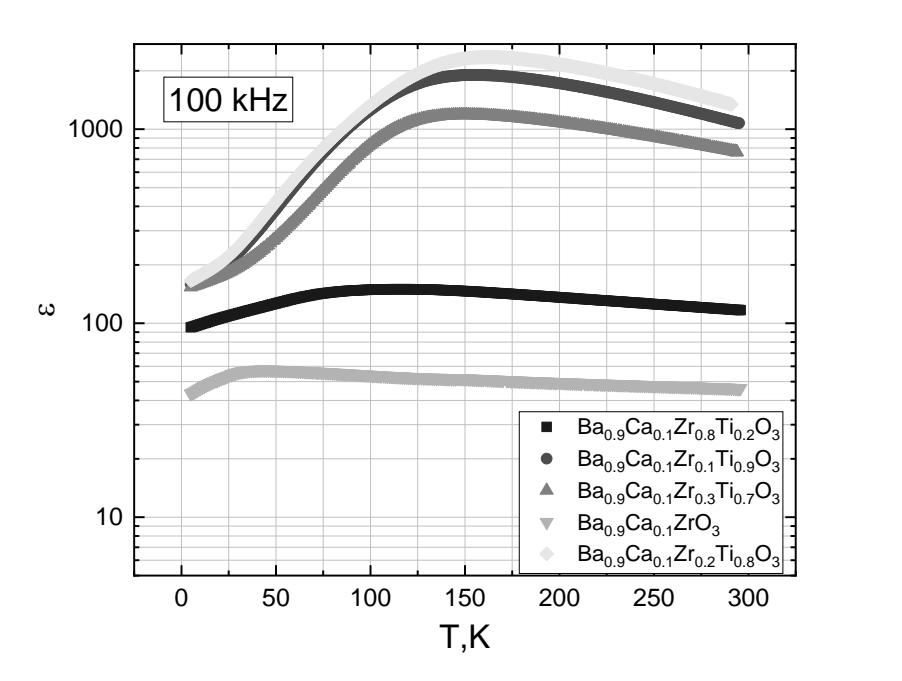
In this presentation dielectric properties of barium zirconate titanate/barium calcium-titanate ceramics (samples with different concentrations of zirconium) will be presented. For Ba0.9Ca0.1ZrxTi1-xO3 (x=1, 0.3, 0.1, 0.2, 0,8) ceramics, the temperature dependence of dielectric constant was measured in the 20Hz-1MHz frequency range HP 4284A precision LCR meter and Closed-cycle Helium cryostate with Lakeshore 331 (6-300 K).
Figure 1 represents the temperature dependence of real part of dielectric permittivity at 100 kHz frequency. The increase of zirconium concentration reduces the maximum value of permittivity while shifting relaxor anomaly to lowest temperatures. No structural phase transition is evidenced in all temperature range. The detailed discussion about the dielectric relaxation will be presented in this work.