
The pseudogap (PG) state, which is realized in high-temperature superconductors (HTSCs) at the characteristic temperature $T^* \gg T_c$ with the doping less than optimal, is one of the most mysterious properties of HTSC cuprates [1]. Understanding the physics of the PG would answer the question about the mechanism of superconducting pairing in HTSCs, which is also not fully clarified yet [2]. One of the most promising materials for studying the PG is the YBa2Cu3O7-δ (YBCO) family. It is so due to the possibility of variation in its composition by substitution of yttrium (Y) with the isovalent analogues, or changing the degree of oxygen nonstoichiometry. The compounds Y1-xPrxBa2Cu3O7-δ (YPrBCO) with partial substitution of Y by praseodymium (Pr) atoms are of particular interest in that respect. The replacement of Y with other rare-earth elements in this compound does not lead to a significant change in its resistive characteristics [1]. The only exception is the replacement of Y with Pr (also known as the 'praseodymium anomaly'), which leads to a noticeable increase in the resistivity $\rho$ and a decrease in the critical temperature Tc of the superconducting (SC) transition [2]. Doping of the Y1-xPrxBa2Cu3O7-δ with Pr on the one hand leads to a gradual suppression of superconductivity with increasing of the concentration x, and on the other, it allows to preserve almost constant both the lattice parameters and the oxygen content (7-δ) of the sample under investigation [1]. It should also be stressed that Pr+3 atoms have an intrinsic magnetic moment of $\mu_{Pr} \approx 3.58\mu_B$, which is $m_{eff} \approx 2\mu_B$ in the PrBCO compound. That is why the study of the effect of Pr impurity on the properties of YPrBaCuO single crystals is considered very promising for revealing the mechanisms of the interplay of the superconductivity and magnetism in HTSC, which is important for the final clarification of the physical nature of both the PG and high-temperature superconductivity ingeneral.
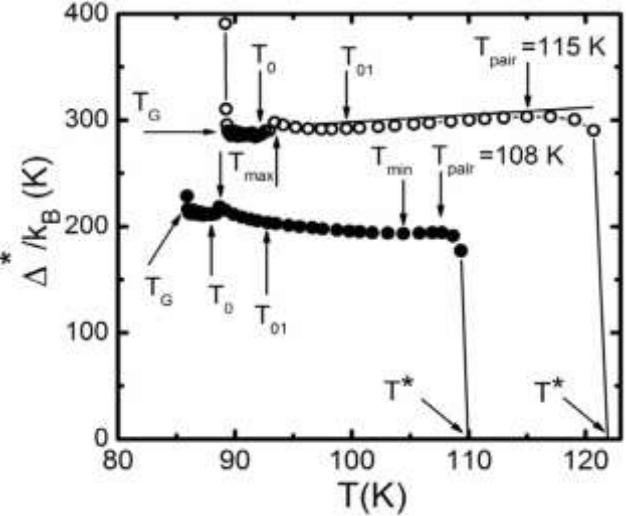
The effect of hydrostatic pressure up to P = 1.7 GPa on the fluctuation conductivity $\sigma$'(T) and pseudogap $\Delta$*(T) in Y0.95Pr0.05Ba2Cu3O7-δ single crystal with critical temperature Tc = 85.2 K (at P = 0) was investigated. The application of pressure leads to the increase in Tc with $dT_c/dP$ = +1.82 K·GPa-1 while the resistance decreases as $dln\rho(100 K)/dP$ = -(10.5 ± 0.2) %·GPa-1. Regardless of the pressure, in the temperature interval from Tc to T0 (~88 K at P=0) the behaviour of $\sigma$'(T) is well described by the Aslamazov – Larkin (AL–3D) fluctuation theory, and above the T0 by the Lawrence – Doniach theory (LD). The Maki-Thompson (MT–2D) fluctuation contribution is not observed. This indicates the presence of structural defects in the sample induced by Pr. Here it is determined for the first time that when the pressure is applied to the Y1-xPrxBa2Cu3O7-δ single crystal, the pseudogap increases as $dln\Delta$*/dP=0.17 GPa-1.