
The laser assisted manufacturing of flat surfaces is a hot topic in the laser community. The ability to change the properties of the surface just by applying high energy pulses is fascinating. After the laser treatment materials can obtain new colors due to recrystallisation, heat assisted chemical reactions, or even surface nanograting formation. Materials can also get other property changes such as wetting or hardness. The interesting ring-shaped features appear after a single shot on the silicon surface heats the scientific community[1,2,3]. It was found that the higher reflectivity ring can be attributed to the silicon chaotic recrystallization and the change of the state of matter induces higher reflectivity[2]. However, the reasoning of the formation is still unclear. We have experimentally and numerically investigated this ring formation induced by intense ultrashort laser pulses.
We focus Pharos (Light Conversion Ltd.) laser beam, having 300fs FWHM pulse duration with central wavelength of 1032nm, to a Silicon surface with a long focal length lens (100mm). The beam diameter at the focus is 14.5 μm FWHM. We observe the energy threshold of the recrystallisation which manifests in formation of the higher reflectivity circle, while the increase of pulse energy forms the ring. We track the inner and outer ring radius with the increase of the pulse energy. The position of the sample can be shifted with the respect of the lens focus, which enables us to easily change the impinging to the surface beam diameter. Therefore, we experimentally obtained data of the ring energy threshold, inner and outer beam diameter change with the change of laser beam diameter and energy.
To explain this phenomenon, we devise a semi analytical expression where linear and two photon absorption is accounted for in the laser energy deposition estimation. We define the absorbed energy threshold to the energy needed to melt the Silicon. This threshold will also serve as the outer ring radius, while the inner ring radius is connected to the energy needed for Silicon to boil. We found that these two above mentioned laser energy absorption mechanisms are not enough to fit the experimental data. To get a better match we had to set the linear absorption coefficient to depend on laser beam fluence. The analytical and experimental points are plotted in Fig. 1 A. For better description of the energy deposition, we developed a numerical code which accounts not only for linear and two photon absorption, but also electron impact absorption which leads to avalanche. After parametric study of the material parameters we observe that indeed the impact absorption is contributing greatly to the laser absorption. Please see Fig. 1 B dotted line representing results of the numerical model with the inclusion of impact ionisation for 25.4μm beam FWHM diameter.
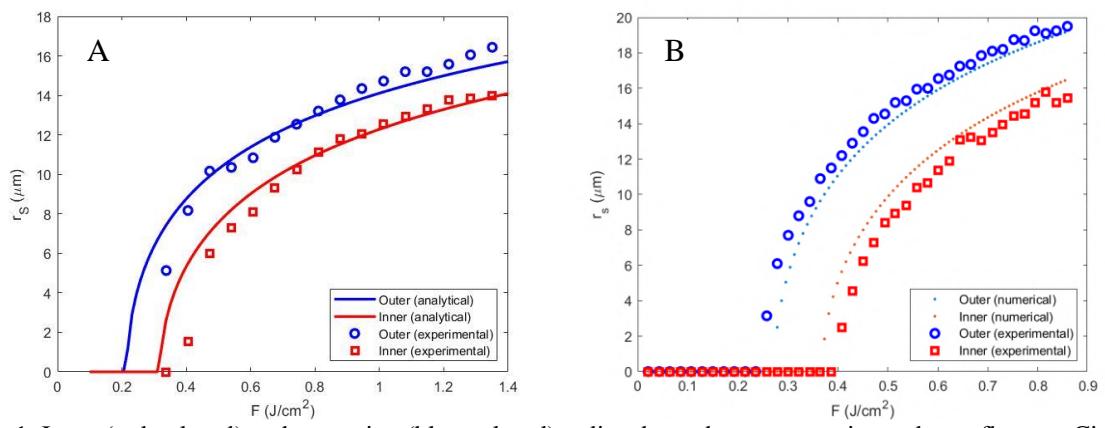
With this experimental and numerical investigation, we can estimate nonlinear absorption coefficients with relatively high precision. We found that the two-photon absorption is 1.98·1010 m/W, and cross-section of bremstrahlung of 1.56·10-22 m2, which are close to the material parameters found in the literature. In the future work we will combine the thermal diffusion model to see whether the heat transfer has an impact on the results.