Carbonic anhydrases (CA) responsible for reversible carbon dioxide's hydration in recent years have become one of the emerging therapeutic targets. However, carbonic anhydrases are linked to many diseases and disorders because of their importance in many physiological processes such as pH regulation, ion transport, or metabolic reactions, where bicarbonate is used as a substrate [1]. For example, CA I is associated with anemia; CA II and CA IV with glaucoma; and CA IX with cancer [2].
Several CA inhibitors are used to control glaucoma, epilepsy, edema, etc. Moreover, one of the important discoveries in recent years was carbonic anhydrase isozyme, specifically CA IX, connection to cancer. Some of the inhibitors for CA IX have already entered preclinical or clinical trials [2]. In the preclinical research step, new drug testing is performed on animals. House mouse (Mus musculus) is the most often used model organism for preclinical drug testing. While orthologous proteins are highly similar, sometimes even small structural differences result in significant affinity variations towards small molecule inhibitors. By producing murine carbonic anhydrases (Car), we will be able to test whether human CA inhibitors that were selected using in vitro methods have comparable affinity and selectivity to murine Car, and thus we could expect more accurate results in the preclinical testing.
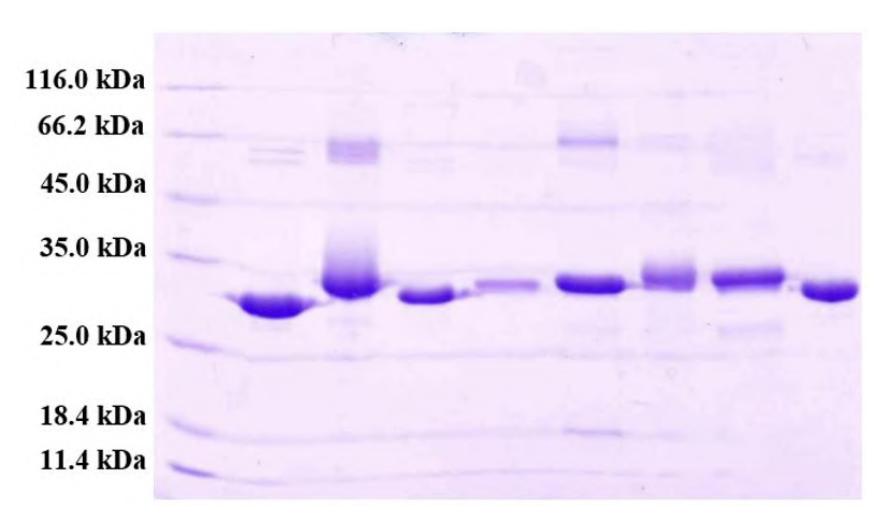
Previously we produced several recombinant mouse carbonic anhydrases [3] [4]. Now we were able to produce most of the active mouse carbonic anhydrases. Most of them were expressed in different Escherichia coli strains and purified by chromatographic methods. Their expression and purity have been confirmed using SDS-PAGE (Fig. 1).