Increasing fluorophore concentration often leads to diminished fluorescence quantum yield, a process that is denoted as concentration quenching, or aggregation-induced quenching [1]. This phenomenon is encountered in many systems from optoelectronics [2] to biology [3]. One example of in vitro quenching appears in chlorophyll solutions, which has been studied since the previous century [3,4].
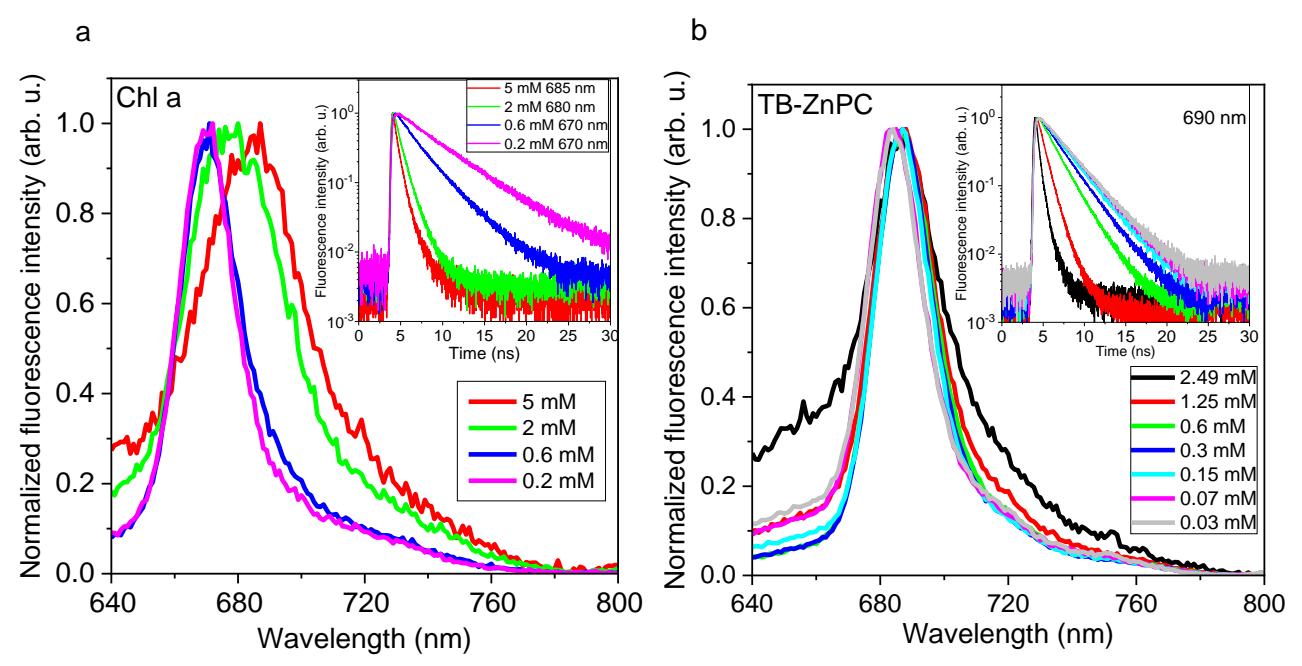
This work demonstrates experiments regarding concentration quenching of Chlorophyll a (Chl a) and Zinc 2,9,16,23-tetra-tert-butyl-29H,31H-phthalocyanine (TB-ZnPC) in thin films. While phthalocyanine molecules show interesting characteristics [5], their resemblance to chlorophyll makes them a potential model system. In Fig. 1a we show normalized fluorescence spectra and fluorescence decay kinetics of Chl a thin films made with toluene and polystyrene (0.288 M) for different concentrations. Redshifting and broadening of emission spectra occurred in the Qy band within increasing Chl a concentration. The fluorescence kinetics were observed to be faster for increased concentration. In Fig. 1b the normalized fluorescence spectra and fluorescence decay kinetics of TB-ZnPC thin films made with toluene and polystyrene (0.288 M) for some concentrations are displayed. Here broadening of the spectra band at higher TB-ZnPC concentration thin films appeared, while the fluorescence decay kinetics demonstrate faster quenching in higher concentration films. This suggests that further examination of these molecules in different environment is needed.