
One of the most serious worldwide problems is counterfeiting of currency, goods, and important documents. These mentioned counterfeits are a huge problem for everyone, including government bodies or big companies. The modern achievements in science and technology create new ways to overcome this serious problem. One of the way to prevent counterfeiting is downconversion and upconversion security pigments, where inorganic luminescence materials are used as security markers and security labels. All of anti-counterfeiting techniques have their advantages and limitations. From this point of view, inorganic luminescent materials doped with rare earth elements improve the security pigments industry due to their unique optical properties.
In this research we represent new inorganic K2Gd(PO4)(WO4) matrix doped with three elements – Yb, Tb and Eu. These materials show unique emission spectra when samples were excited with 340 nm and 980 nm (laser) wavelength. Due to the energy transfer from Tb3+ to Eu3+ the most intense emission lines are observed in red spectral region (590 – 720 nm).
In order to investigate upconversion luminescence Gd3+ ions are replaced by 10% Yb3+ ions. The Yb3+ absorbs 980 nm laser radiation, transfers the energy to Tb3+, which, in turn, transfer the energy to Eu3+. As it was expected the intensity of the most intense Eu3+ 5D0 → 7F2 transition at 614 nm increase with increasing Eu3+ concentration.
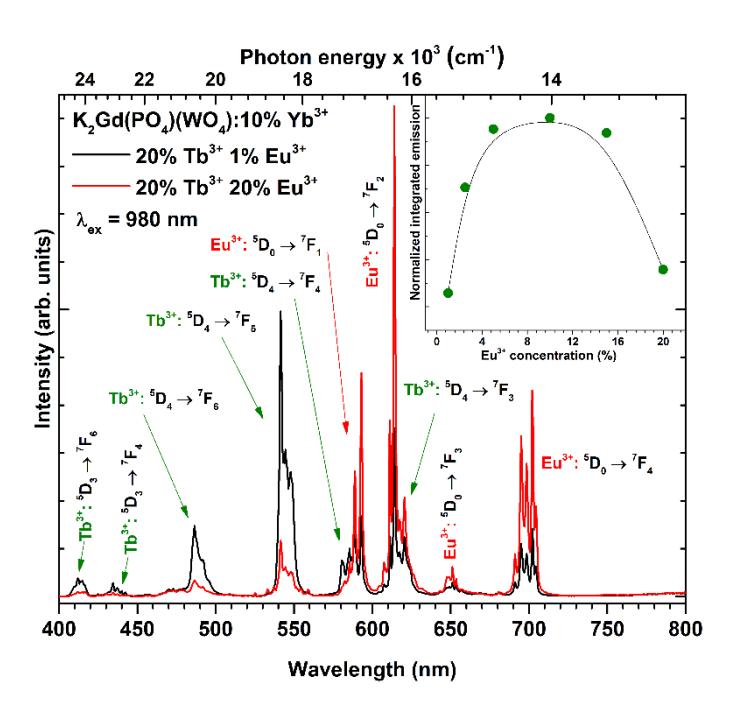
The upconversion emission spectra of the K2Gd(PO4)(WO4):20% Yb3+ doped with 1% and 20% Eu3+ were measured and depicted in Figure 1. The inset of the graph shows normalized integrated emission intensity of all synthesized samples as a function of Eu3+. The normalized integrated emission intensity of the samples increases if samples are doped with up to 10% of Eu3+. Increasing Eu3+ content further leads to decreasing of the intensity what could be attributed to energy transfer between Eu3+ and Tb3+ ions. The upconversion PL spectra for both phosphors doped with 1% and 20% of Eu3+ show typical emission lines which could be attributed to Tb3+ and Eu3+.
Characterization and investigation of the optical properties of the synthesized compounds will be discussed during the presentation.