
Air pollution is caused by various anthropogenic activities, i.e., industrial emergence, urbanization, forest burning, and vehicular exhausts, posing a serious threat to human health and the environment [1]. This research project is composed of the basic research analysis related to the air pollution in the specific bus terminals in the study areas of Peshawar and Lahore (Pakistan). Particulate matter (PM) is one of the major air pollutants, whose concentration is exceeding the World Health Organization (WHO) guidelines values and National Environmental Quality Standards (NEQs) values throughout the major cities of Pakistan [2]. A high-volume Reference Ambient Air Sampler (F&J) based on 24-h duration was used to collect the PM10 samples (n=96) on glass fiber filter paper. Furthermore, the collected samples were analyzed for the concentrations of lead (Pb) bound to the PM10 (PM with a diameter of 10 microns or less). For this purpose, the analysis was conducted via an Atomic absorption spectrometer (Perkin Elmer, AAS-PEA-700). The sampling period was divided into two seasons, i.e., summer from June to August (2019) and winter season from November to January (2019-20), respectively. The mean concentrations of PM10 in the Peshawar section of Haji camp bus terminal and Kohat bus terminal were 413 μg/m3 and 396.3 μg/m3 in summer whereas, in the winter season concentration were 492.5 μg/m3 and 468.5 μg/m3. Similarly, the mean PM10 concentrations for the Section Lahore, Niazi bus terminal, and Badami Bagh bus terminal were 478.2 μg/m3 and 531.8 μg/m3 in summer whereas, in the winter season concentrations were 708 μg/m3 and 784 μg/m3, respectively. The mean concentrations of Pb in the Peshawar section study area were 532.2 ng/m3 in Haji camp bus terminal and 489.1 ng/m3 were in the Kohat bus terminal in the summer season, whereas, for the winter season the mean concentrations were 732.7 ng/m3 and 692.9 ng/m3, respectively. The mean concentration of Pb in the Lahore section of the study area were 624.9 ng/m3 in the Niazi bus terminal and 674.9 ng/m3 in the Badami Bagh bus terminal in the summer season, whereas, in the winter season the mean concentrations were 837.6 ng/m3 and 910.5 ng/m3, respectively.
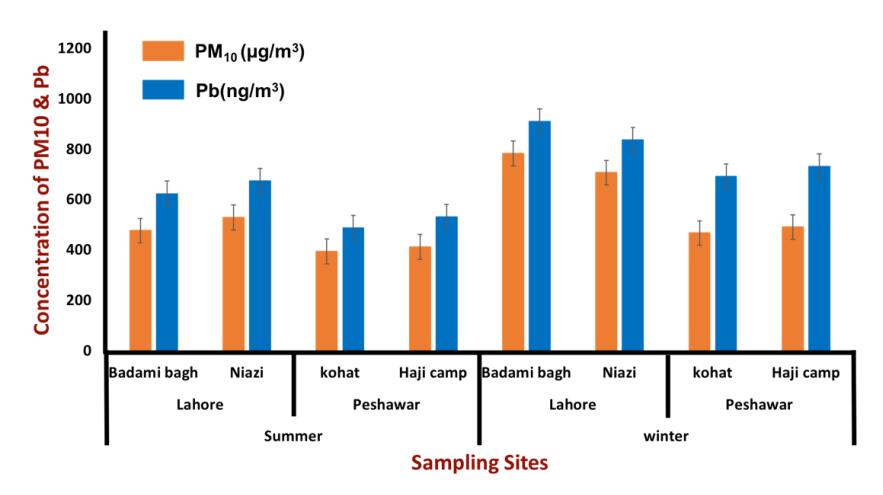
Fig.1 indicated that the PM10 and Pb concentration in both the terminals of Peshawar (Haji camp terminal and Kohat terminal) and Lahore (Badami bagh terminal and Niazi Bus terminal) was lower in the summer as compared to the winter season. The analysis of correlations showed that the concentrations of PM10 collected at all sampling sites are positively correlated to the concentration of Pb and traffic intensity. The correlation value ranged from 0.35 to 0.96 whereas the values of correlation in the Peshawar section of the study area are a bit less positive as compared to Lahore. Furthermore, the results of Lahore as compared to Peshawar show a more positive correlation in both the summer and winter seasons. The statistical analysis of ANOVA showed a significant (0.05) difference in all the four selected study sites in both the summer and winter seasons.