
Alkaline fuel cells (AFCs) convert chemical energy into electricity in a clean and highly efficient way with a low impact on the environment. The oxygen reduction reaction (ORR) is one of the most important reactions in fuel cells because most alternative cathode reactions are not practical [1]. The ORR as the cathodic reaction in alkaline media follows either four-electron (eq. 1) or the alternative two-electron mechanism (eq. 2) which is followed by further reduction of generated hydrogen peroxide (eq. 3a) or by its decomposition (eq. 3b) [1]:
$$O_2 + 2H_2O + 4e^- \rightarrow 4OH^- \quad E^0 = +0.401 \text{ V vs. SHE} \tag{1}$$$$O_2 + H_2O + 2e^- \rightarrow HO_2^- + OH^- \quad E^0 = +0.065 \text{ V vs. SHE} \tag{2}$$$$HO_2^- + H_2O + 2e^- \rightarrow 3OH^- \quad E^0 = +0.867 \text{ V vs. SHE} \tag{3a}$$$$2HO_2^- \rightarrow 2OH^- + O_2 \tag{3b}$$ORR is kinetically sluggish, so efforts have been made to improve the efficiency of this reaction in alkaline media, and thus the performance of AFCs. Some research is focused on non-platinum electrocatalysts due to their low cost and high abundance [1]. In this study, Raman spectroscopy was used for characterization of the reduced graphene oxide and transmission electron microscopy (TEM) for examining the morphology and microstructure of the CoAg/rGO electrode. Two characteristic peaks of graphene oxide known as D and G bands were observed at Raman spectra [2]. TEM image shows diameters of nanoparticles of CoAg/rGO electrocatalyst to be up to about 9 nm.
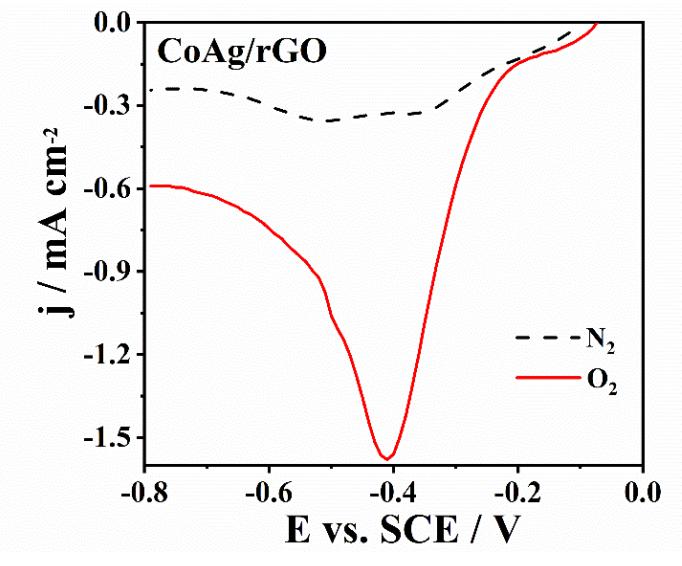
CoAg/rGO was examined in N2- and O2- saturated 0.1 M KOH solution (Fig. 1) by linear sweep voltammetry (LSV). ORR peak current density of -1.58 mA cm-2 of CoAg/rGO was obtained at -0.41 V in O2- saturated 0.1 M KOH solution. Increasing current density of 1.3 mA cm-2 at -0.4 V in O2- saturated solution compared with current density obtained in N2- saturated solution clearly showed that CoAg/rGO electrocatalyst is active for ORR [3]. This CoAg/rGO nanosize ORR electrocatalyst could be a good replacement for costly Pt electrocatalysts because of its fast, easy, and low-cost synthesis.