
In order to increase the primary beam intensity in next generation of radioactive ion beam installations, the production of targets capable of dissipating high beam power, especially for molten targets, is a major challenge. In that context, a direct molten loop concept was proposed for short-lived isotopes by EURISOL. To validate this concept a target prototype was designed and assembled, called LIEBE, in the ISOLDE operation environment [1].
The aim of this work was to develop a MCNP model of liquid lead LIEBE target and perform preliminary simulations of proton beam impact. To achieve this a detailed CAD model of the target was converted to an MCNP readable format using SALOME software McCAD module. The CAD model needed to be manually decomposed before the conversion, since the geometry of the LIEBE target was complex and detailed. For this reason, many elements of the model needed to be manually modified as well.
Developed model was used for the MCNP simulation of incident proton beam. The proton flux distribution after the impact was evaluated and maps were produced (Fig. 1). FENDL-3.1 cross-section data library has been used.
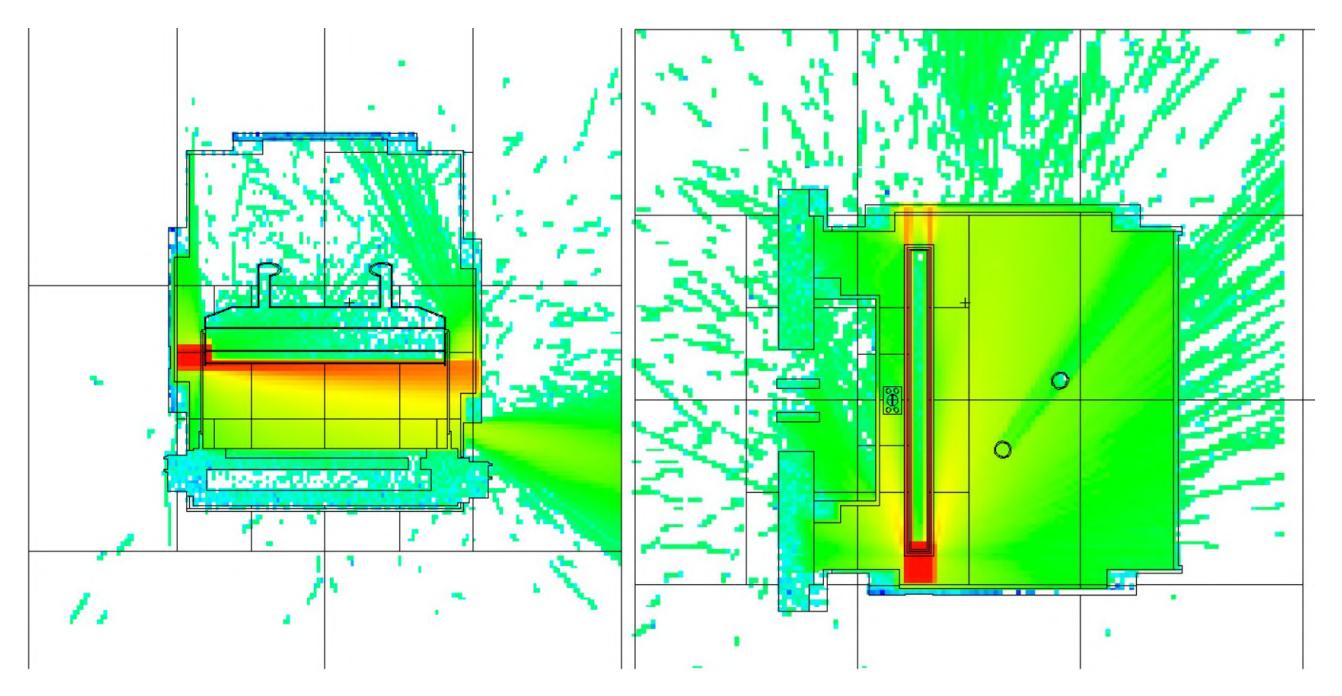
Preliminary results revealed that the proton beam window's should be revised in CAD and MCNP models, in order more protons hit the target at the required position. From the produced proton flux maps it can be seen that part of the beam penetrates under the LIEBE target construction. Therefore, from a radiation safety perspective, certain biological safety measures will be evaluated in the future under this study.