
Oaks (Quercus spp.) are perennial, widespread throughout the Northern Hemisphere trees of whose certain parts can have a positive impact on human life. Knowing that the common oak (Quercus rubra L.) is a naturally growing oak in Lithuania, its fruits were selected for research. Acorns are the fruit of the oak, also known as oak nuts. Acorns are a natural food that has been used in the diet of people for thousands of years. However, research shows a wider use of acorns due to the antioxidant and antibacterial potential of phytochemical compounds in the acorns.
Acorns are known to have antioxidant activity [1]. However, it is known that antioxidant activity depends both on the sample preparation technique and geographic origin of the natural object. Different treatments of acorns can affect their phytochemical compounds. Fermentation, soaking, germination and enzymatic treatment are methods used to reduce toxic compound presence in acorns - phytic acid, in order to increase an application of acorns in food industry [2]. Moreover, heat-treated acorns have lower levels of tannins but higher levels of phenolic compounds [3]. Due to the lack of data on the acorns' biological activity of oaks growing in Lithuania, the aim of this study was to evaluate the impact of acorns' treatment on their antioxidant activity. Acorns were collected in 5 different Lithuanian regions (Kaunas, Šilutė, Jonava, Kretinga, Kėdainiai). Three treatment methods were applied, i.e. soaking in water at 45 °C for 18 hours, drying at 37 °C for three days, and drying at 200 °C for 15 minutes. After treatment, methanolic extracts were prepared and tested using spectrophotometric tests for evaluation of the total content of phenolic compounds and flavonoids.
The study showed that the antioxidant properties of acorns were depended on the collection region and sample treatment method (Fig. 1). The highest content of phenolic compounds was found in the Kretinga region (57.6 mg/g) after the treatment of acorn at 200 °C, while similar results (57.5 mg/g) were determined in Jonava after the treatment of acorn at 37 °C. Additionally, it is noticeable that the lowest amount of flavonoids was found in the extracts from Kaunas acorns despite the treatment. Total flavonoid content varied in the range from 1.4 to 2.8 mg/g, depending on the acorns collection region and the treatment.
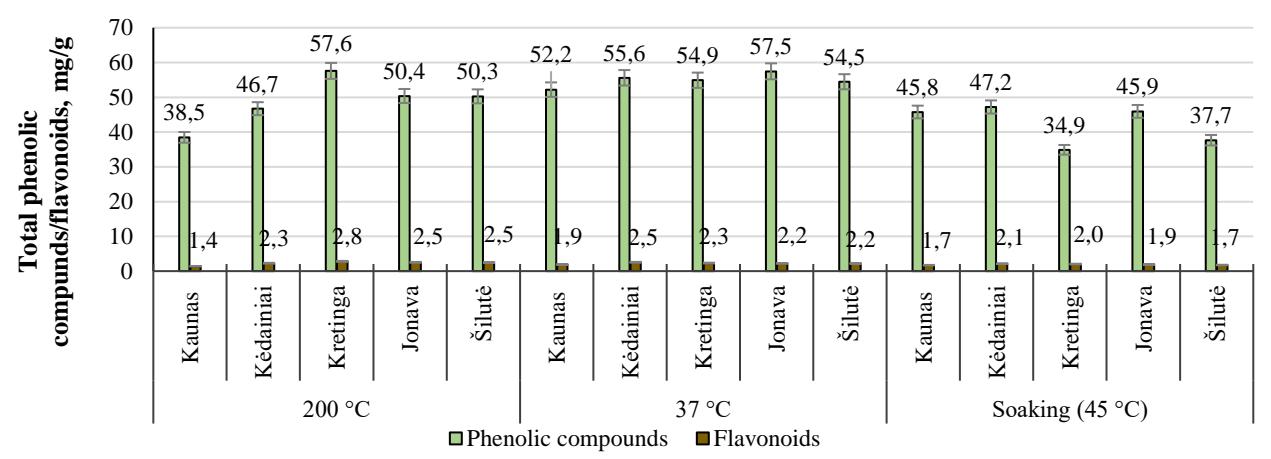
There is no clear tendency from the current data on the dependence of total phenolic compounds and flavonoids on the acorns' treatment method. The amount of biologically active compounds depends not only on the method of treatment but also on the acorns' collected region. It is obvious that the treatment of the acorns affects the total amount of phenolic compounds extracted from acorns as the differences between the individual methods are as high as 50 percent.