Over the past decades, the Kohn-Sham density functional theory (DFT) [1] has become the main tool to investigate the atomic and the electronic structure of solids. While being in principle exact, the theory needs to invoke approximations to the so-called exchange-correlation (XC) contribution to the total energy, as the exact form of this contribution is unknown. Currently, the most popular functionals applied to solids are semilocal functionals based on the generalized-gradient approximation (GGA), in particular the Perdew-Burke-Ernzerhof (PBE) functional [2], and hybrid functionals that incorporate a fraction of (screened) Fock exchange, especially the Heyd-Scuseria-Ernzerhof (HSE) [3]. The biggest drawback of the GGA functionals is the well-known under-estimation of the band gap of semiconductors and insulators. Hybrid functionals provide a much improved description of the electronic structure, including the band gap, albeit at a much increased computational cost.
In 2015, a new semilocal meta-GGA class functional SCAN was introduced [4]. The advantages offered by the SCAN functional are particularly relevant for point defects in solids. These systems are most conveniently modelled using the supercell-approach. The supercells typically contain a few hundreds of atoms, and computational efficiency is important here, especially when analyzing many point defects. In addition, a better description of the band gap of the host material leads to a better description of defect levels that are situated in the band gap. However, despite an increasing popularity of the SCAN functional in modeling bulk materials [5], its application to defects has been scarce so far [6]. Thus, the benefits of the SCAN functional in the modelling of defects are currently little known.
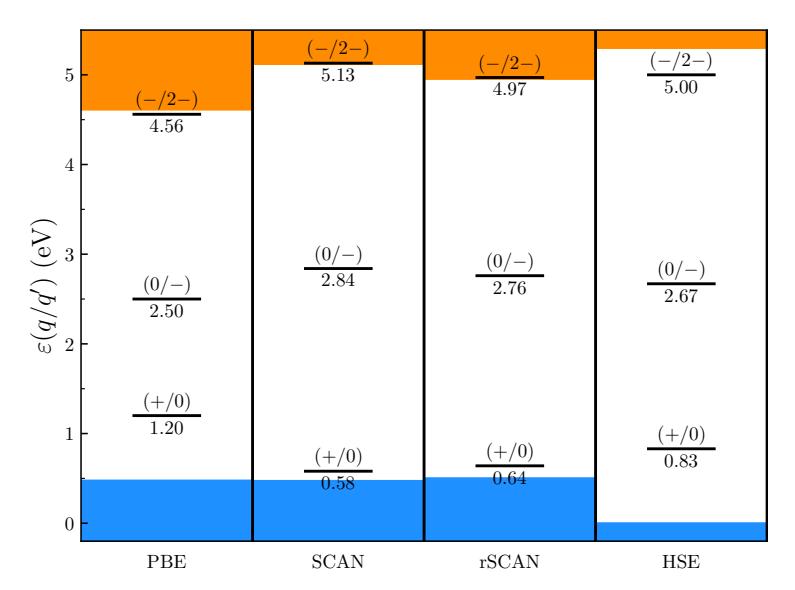
In this work, we benchmarked the SCAN density functional for colour centres in diamond. Our chosen defects were: the nitrogen-vacancy (NV) centre, the silicon-vacancy (SiV) centre, and the germanium-vacancy (GeV) centre. Over the past two decades, these colour centres have gained prominence in various quantum-technological applications, in particular in quantum sensing, quantum communication, and even quantum computing. Our goal was to compare the parameters computed with the SCAN functional with those obtained using more traditional PBE and HSE functionals. These parameters were: formation energies, charge-state transition levels, optical excitation energies, lattice relaxation energies, as well as Jahn-Teller parameters. As a prerequisite, we applied the SCAN functional to bulk diamond, and compare the obtained results with PBE and HSE functionals. Our results show that the meta-GGA functionals SCAN and rSCAN yield very good results for modelling of colour centres in diamond and are often good alternatives to hybrid functionals.