Candida species have been reported as the fourth most frequent microorganism that cause bloodstream infections in clinical settings and are the predominant fungi isolated from medical device infections. The ability of this pathogen to form biofilm is the mainly virulence factor which contributes for the persistence of Candida infections associated with high mortality rates (~ 50%) [1, 2]. Thus, several approaches/therapies are being studied to overcome the C. albicans biofilm. However, some of them are still in preclinical stages of development and others shows disadvantage such as: specificity for one microbial species, intrinsic mutagenesis and damage to host cell [1].
Antimicrobial photodynamic therapy (aPDT) appears to be an interesting alternative once presents multiple targets process (no development of microbial resistance) and selective killing of microbial cells with minimal damage to the host tissues [3]. aPDT involves the synergistic combination of a photosensitizer (PS), molecular oxygen and visible light of appropriate wavelength in order to produce highly reactive oxygen species (ROS), which leads to the oxidation of several cellular components and to rapid cell inactivation [3]. Despite aPDT advantages, the EPS 'trapping' decreases the PS accumulation into the biofilms and hampers the PS access to the biofilm bottom layers. The electroporation technique (PEF) may be an attractive technique to overcome that and enhance the aPDT effectiveness.
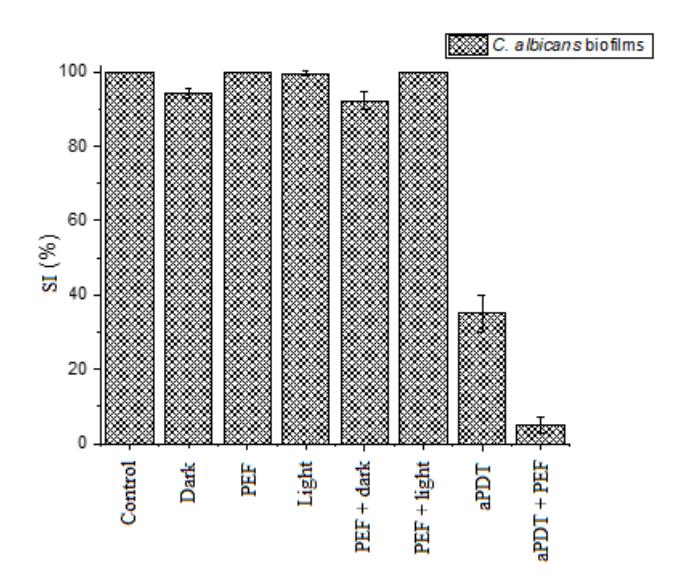
Thus, this study aimed to investigate the synergism between aPDT and electroporation to overcome C. albicans biofilms. A mature biofilm of C. albicans was performed on cellulose membrane (48 hours – 37°C) and exposed to aPDT (1mg mL-1 of methylene blue, light dose 40 Jcm-2 - 630 nm), following electroporation (50 μs duration, 1 Hz frequency, 1000 Vcm-1). The results showed the beneficial effects aPDT/PEF once inhibited about 30% and 80% more microbial cells compared to aPDT and PEF alone, respectively. In addition, the Light (only light) and Dark (methylene blue only) controls did not promoted a substantial effect against C. albicans biofilm. Based on these results we suggest that PEF can potentiate the aPDT effect.