The non-stationarity of the human EEG signal has been well-established. It is of interest to find a method of dividing the EEG signal into quasi-stationary spells to determine its local properties. One proposed method to achieve this, which has been introduced and on other biological signals by [1], is using an algorithm utilizing the Kolmogorov-Smirnov test for comparing empirical distribution function between two samples.
This presentation will cover the performance of this segmentation algorithm (the KS segmentation) for artificial Gaussian series and for series that have been used as models of the EEG: 1/f-like noise and autoregressive series. To evaluate the performance, normalized mutual information and number of segments identified are used. It was found that the algorithm accurately segments Gaussian series in a wide range of parameters. For the 1/f-like and AR series oversegmentation occurs. This indicates a direction for possible improvement of the KS segmentation algorithm.
KS segmentation has been then applied to the EEG of subjects participating in the Eriksen Flanker Task – a task commonly used in psychology to study detection of a target in presence of distraction. The subjects in the task are presented a target arrow pointing either left or right, surrounded by other arrows (distractors) which either all point left or right. In each trial the subjects are asked to press a button indicating the direction of the target arrow. This task is known to elicit a specific pattern of event-related potentials – peaks in segments of EEG signal (epochs) surrounding the response, averaged over many trials.
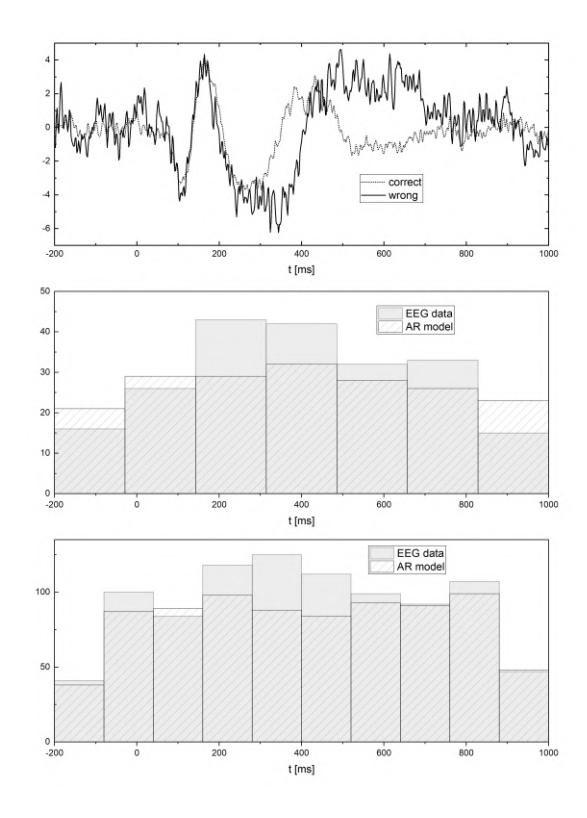
In spite of the EEG signal having a non-Gaussian, heavy-tail distribution, when segmentation is performed on many epochs and its distribution density is calculated, the results appear to reproduce the pattern present in the event-related potentials (as shown in Fig. 2). This suggests that KS segmentation might offer an alternative to the prevalent event-related potential method which would allow for human response detection on a single-trial basis.