Aqueous sodium-ion battery (NIB) technology is one of the alternatives to the lithium batteries due to the low cost, abundance of sodium and environmental friendliness. Exploration and development of suitable positive and negative electrode materials are critically important for high-performance of NIBs. Among all polyanionic compounds, phosphates particularly gained a great deal of interest, because of their excellent structural stability due to the strong P-O chemical bond, while compared to sulfates which have low thermal decomposition and high moisture reactivity [1]. The NASICON (Na Super Ionic Conductor) family of phosphates has been extensively studied. Thanks to the excellent tunability of the NASICON type structure, it can accommodate a wide selection of transition metals, e.g. Fe3+, Ti3+, Zr3+, V3+ and Mn3+. Indeed several mixed-metal materials have been reported such as Na3MnTi(PO4)3 [2], Na3MnZr(PO4)3 [3] and Na4MnV(PO4)3 [4]. One of alternatives for NIBs cathodes is novel Na4FeV(PO4)3 material which has active Fe2+/Fe3+ and V3+/V4+ redox couples[1,5] and could possibly work not only as cathode but also as symmetrical cathode/anode battery.
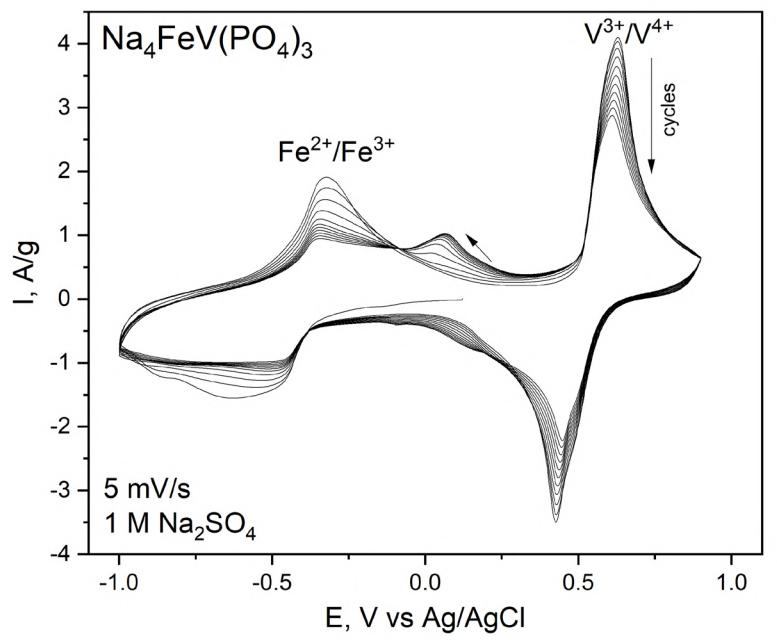
In this investigation, we prepared pure phase Na4FeV(PO4)3 via solid-state synthesis method using Na2CO3, V2O3, FeC2O4·2H2O and NH4H2PO4 precursors. The structure and morphology of prepared materials were characterized by X-ray diffraction, scanning electron microscopy and thermogravimetric analysis. The electrochemical properties of prepared electrodes were investigated by cyclic voltammetry (Fig. 1) and charge/discharge galvanostatic cycling using different aqueous electrolytes.