Application of renewable power sources (e.g. wind and solar power plants) carries new challenges concerning energy storage. One of the remedies to stabilize their output is the utilization of battery storage stations. In this field, sodium-ion batteries (NIBs) are expected to be a sustainable and cheap alternative to lithium ones [1].
Materials called alluaudites, first described by Fisher in 1955 [2], are among prospective cathode materials for NIBs, with the theoretical gravimetric capacity close to 170 mAh/g [3]. In our research, we studied materials with nominal composition of Na2M3(PO4)3 (M = Fe, V, Mn). Another interesting compound is Na3M2(PO4)2F3 (M = V, Ti, Fe) with the NASICON structure (theoretical capacity reaching ca. 192 mAh/g) [4-5]. Poor electrical conductivity is one of the main obstacles to their implementation.
Thermal treatment of glassy samples led to nanocrystallization of alluaudite or NASICON phase [6-7]. Previous studies on amorphous analogues of cathode materials for Li-ion batteries show a significant increase of electrical conductivity as a result of their thermal nanocrystallization, due to the occurrence of the preferable conditions for polaron hopping mechanism of conduction [8]. We have shown that a similar procedure can be successfully applied to sodium compounds as well. We observed a significant (5 orders of magnitude) and irreversible increase of conductivity, which resulted in nanomaterials with $σ$(25°C) $\approx$ 1 mS/cm. We also elaborated optimal syntheses conditions to obtain alluaudite-like nanomaterials with maximum possible phase purity.
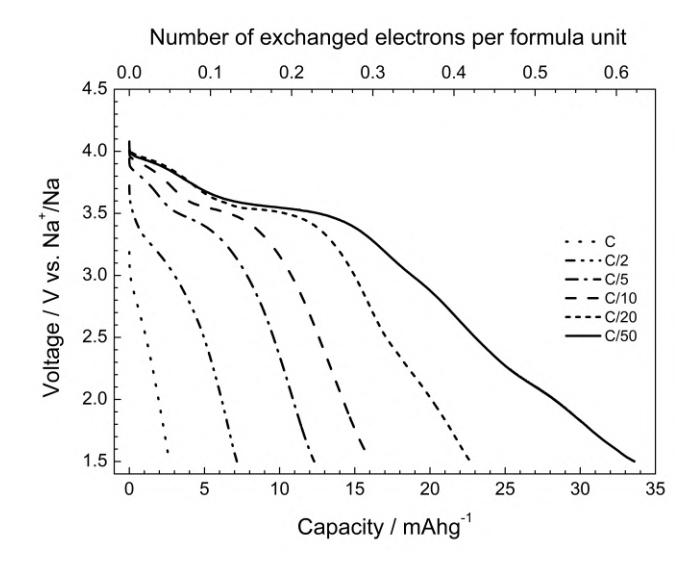
Optimization of nanocrystallization process allowed us to assemble and test our materials as cathodes in prototype sodium-ion cells. They were tested at various current rates. Practical capacities generally did not exceed 60 mAh/g and cells often suffered from modest cycle life and limited rate performance. There is, however, place for improvements and presented results can be a good basis for further research.