
To ensure precise measurements and low detection limits, the light sources used for the atomic absorption spectroscopy must meet certain criteria – the spectral lines used in the analysis must be narrow, stable in time and have no self-absorption. It is also preferable for the light sources themselves to have long lifetimes.
In this work we compare some spectral properties of high-frequency electrodeless lamps (HFEDL) and hollow cathode lamps (HCL) with arsenic filling. We measured relative and absolute intensities of several spectral lines in the UV region as a function of power, and afterwards compared the radiation intensities for both types of the light sources in the relative and absolute units. The registration of the spectra was done by the spectrometer Jobin Yvon SPEX 1000M. An identification of spectra was performed, along with the observation of the behavior of the spectral lines, when the generator voltage or the current was changed.
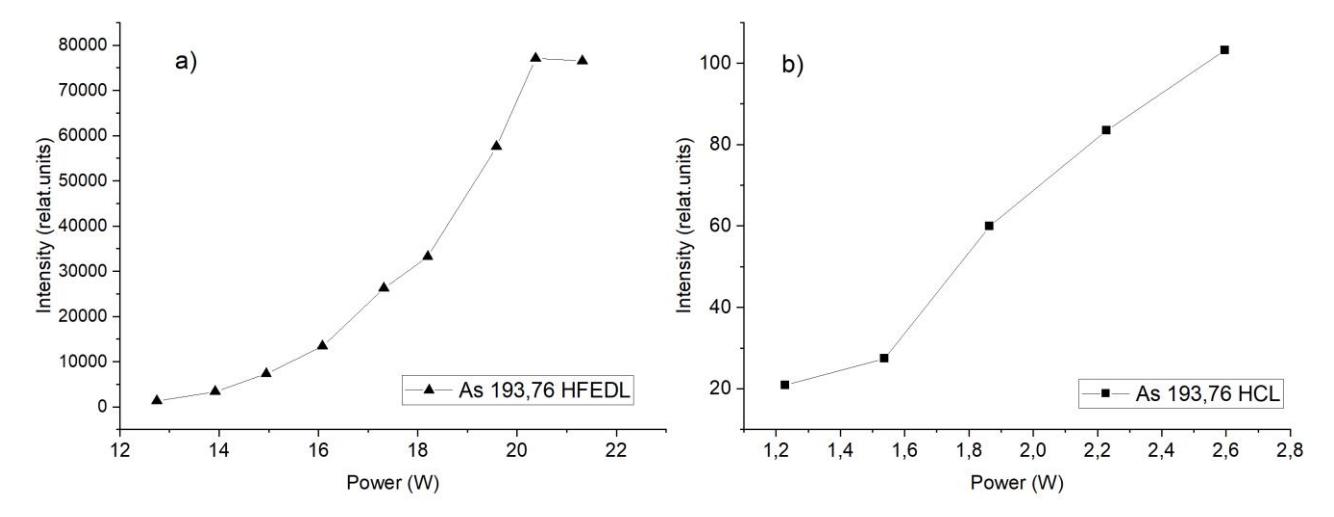
In Fig. 1 an example of the relative intensity values depending on the operating power for the As 193,76 nm atomic spectral line in both of the light sources is shown. Graph a) shows that the relative intensity of the chosen spectral line in the high-frequency electrodeless lamp increases exponentially with the increasing power. For the HCL (graph b), the increase of the intensity is linear.
The operating power value range of the HFEDLs and the HCLs is influenced by the physical properties of the light sources, and is limited on both ends by the lamp and excitation generator properties. In our case the difference is about 10 times – as the HFEDLs are operated at approximately 10 times higher power values than the HCLs. While we are not able to compare the spectral line intensity at the same power values, the results clearly indicate that for the respective power regions the relative intensities of the arsenic spectral lines are significantly higher for the HFEDLs. Similar results are expected when comparing the absolute intensities.