Nonpolar (a- or m-plane) InGaN/GaN multiple quantum wells (MQWs) attract attention due to the absence of polarization-related electric field, which should improve the optical performance, and capability to emit highly polarized light. On the other hand, non-polar InGaN structures often exhibit two bands in the photoluminescence (PL) spectrum, with their origin still unclear. To gain more insight about the origin of double-band emission, the time evolution of the two PL bands was studied by time-resolved photoluminescence spectroscopy (TRPL).
In this work, we present the study of PL decay in non-polar InGaN/GaN MQWs with the main focus on the decay of different PL bands. The PL spectra of seven m-plane InGaN/GaN samples were measured at different delay times under several excitations. The seven samples under study can be categorized into three groups: i) structures having the same QW and barrier thicknesses of 8 and 9 nm, respectively, but with different In content from 9% to 13%; ii) structures with the same In content of 13% in the QWs, but having different QW and barrier thicknesses; and iii) additional pair of samples with In content of 14% and QW width of 4 nm, deposited at slightly different growth conditions.
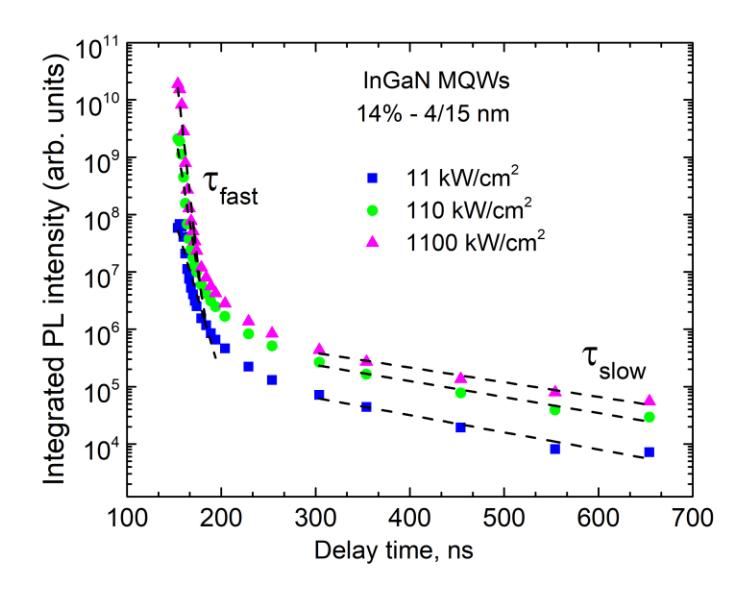
All the studied m-plane InGaN structures showed double-band emission, except for one sample with 9% of In. The typical time dependence of spectrally-integrated PL intensity is shown in Fig. 1. A clear nonexponential decay is observed for all excitations. In this case, the PL dynamics can be characterized by two decay times - fast and slow components of bi-exponential function. The characteristic time of the fast initial decay is similar to the laser pulse duration of 4 ns. Meanwhile, the slow component of PL intensity decays with characteristic time of ~200 ns and might be attributed to the radiative recombination of deeply localized carriers and/or defects. For the studied samples, the PL intensity decay at highest excitation varies around 200 ns and decreases to approximately 170 ns for lower excitations. The longest decay time (~250 ns) is reached in the sample with 13% In content, 8 nm QW width and 15 nm barriers. Analysis of the individual PL bands revealed their different decay rates: the short-wavelength band decayed faster. Such behaviour was attributed to the carrier capture to localized states and/or defects.