Aerosol particles affect the climate directly modifying the global radiation budget by scattering and absorbing solar and terrestrial energy. Furthermore, they have negative impact on human health, reduce visibility, and act as a cloud condensation nucleus (CCNs). Therefore, it is crucial to understand the influence of temperature on aerosols chemical composition [1].
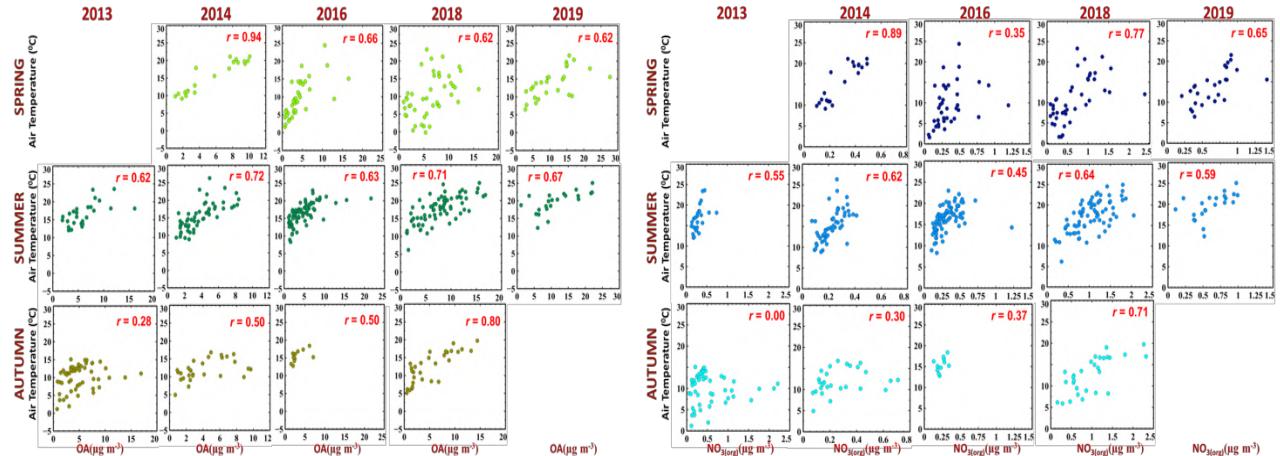
Correlation of organic and inorganic aerosol compounds with ambient temperature were analysed in Rūgšteliškis (Lithuania) rural environment. The analysis of 5 years (2013, 2014, 2016, 2018 and 2019) data series was performed for 3 seasons (spring, summer and autumn). Correlation coefficients between organics (Org) and daily averaged temperature in spring 2014, 2016, 2018 and 2019 are presented in Fig. 1 and in Table 1. The varied colors in Table 1 indicated the intensity of the correlation coefficient, such as red (strong correlation), green (moderate correlation), and blue (no correlation). It can be seen, that in spring and summer there is a strong positive correlation between Org and temperature but only a moderate correlation in the autumn. Furthermore, the correlation of Org with temperature in all the 3 seasons varies within different years, for instance, in 2018 correlation coefficient was r = 0.62 for spring, r = 0.71 for summer, and r = 0.80 for autumn respectively. This higher correlation during autumn 2018 could be associated with about 1.8 – 2.8 °C higher monthly averaged temperature than long-term statistical average for autumn in these latitudes.
| Seasons | 2013 | 2014 | 2016 | 2018 | 2019 | |
|---|---|---|---|---|---|---|
| Org | Spring | 0.94 | 0.66 | 0.62 | 0.60 | |
| Summer | 0.62 | 0.72 | 0.63 | 0.71 | 0.52 | |
| Autumn | 0.28 | 0.50 | 0.50 | 0.80 | ||
| NO3(Org) | Spring | 0.89 | 0.35 | 0.77 | 0.63 | |
| Summer | 0.55 | 0.62 | 0.45 | 0.64 | 0.41 | |
| Autumn | 0.00 | 0.30 | 0.37 | 0.71 | ||
| NO3(Inorg) | Spring | 0.05 | 0.22 | -0.45 | 0.10 | |
| Summer | 0.40 | 0.44 | 0.28 | 0.11 | -0.46 | |
| Autumn | -0.07 | 0.16 | 0.42 | -0.07 | ||
| SO4 | Spring | 0.79 | 0.59 | 0.32 | 0.43 | |
| Summer | 0.47 | 0.63 | 0.63 | 0.59 | 0.30 | |
| Autumn | 0.30 | 0.01 | 0.37 | 0.78 | ||
| NH4 | Spring | 0.83 | 0.14 | -0.12 | 0.33 | |
| Summer | 0.59 | 0.71 | 0.45 | 0.63 | 0.41 | |
| Autumn | 0.28 | 0.06 | 0.36 | 0.72 |
A strong correlation was observed between organic nitrates (NO3(org)) and temperature over springs in 2014, 2018, and 2019 (Fig. 2). In addition, the higher values of correlation coefficients were observed over summers (Table 1). These results revealed that there is a strong positive link between NO3(org) and temperature during warmer seasons. Meanwhile, the same correlation showed different results during autumns: no correlation in 2013 (r = 0.00), weak correlation in 2014 and 2016 (r = 0.30 and r = 0.37, respectively) and quite strong correlation in 2018 (r = 0.71) (Fig. 2). The latter strong correlation could be likely associated with about 1.8 - 2.8°C higher monthly averaged temperature comparing to long-term statistical average for autumn in these latitudes.
In addition, inorganic nitrates (NO3(Inorg)), sulphates (SO4), ammonium (NH4), and chloride (Chl) correlation with temperature in 2013, 2014, 2016, 2018, and 2019 were calculated (Table 1). Obtained results indicated that NO3(Inorg), SO4, NH4, and Chl has no correlation with temperature in all the three seasons (spring, summer and autumn).