Plant genetic engineering not only helps to improve yields, health, and resistance of plants, but also could be used to produce recombinant proteins, vaccines, and biofuels [1]. Methods for plant cultivation under closed environment conditions (in vitro) provide effective solution for the use of genetically modified plants. Application of the technology of molecular farming for production of biological raw materials - provides cost and product quality-effective alternatives as compared to traditional sources, and it could be easily adapted for the large-scale industrial production [2, 3]. Our aim is to develop the technology for plant tissue cultivation under in vitro conditions that is dedicated for production of specific peptides mimicking the functional domains of extracellular matrix proteins (PMEM), collagen-mimetic peptide (CMP) in particularly. Specific challenges that are addressed in this work - to selection of tissue type and growing conditions that ensure production cost and peptide function-efficient plant raw material preparation.
Transformation of tobacco leaf explants were achieved using Agrobacterium tumefaciens. Using green fluorescence of the GFP marker under ultraviolet light at 530 nm was used to select three transgenic lines (N1, N2 and N3) of tobacco callus which were further used to initiate cell suspensions. Tobacco callus clones were grown on agarized Murashige and Skoog medium with 3% sucrose and different combinations of growing regulators: 1 mg/l BAP, 0.1 mg/l NAA (RM1), 0.25 mg/l BAP, 2.0 mg/l NAA (TK1) and 0.1 KIN, 1.0 mg/l NAA (TKSIM). Callus clones and cell suspensions were grown at 24, 27 and 31 °C temperatures under 16-hour photo period and transplanted regularly every two weeks. Cell suspensions were stirred at 100 rpm on a shaker in liquid medium. Control (untransformed tobacco callus and cell suspensions) were grown under the same conditions. After two weeks cell suspensions were centrifuged for 15 minutes at 2000 rpm. The supernatant obtained was filtered off with suction and the mass was weighed. The increase in biomass compared to the initial weight is calculated. Statistical analysis was performed using the ANOVA test of the MS Excel package.
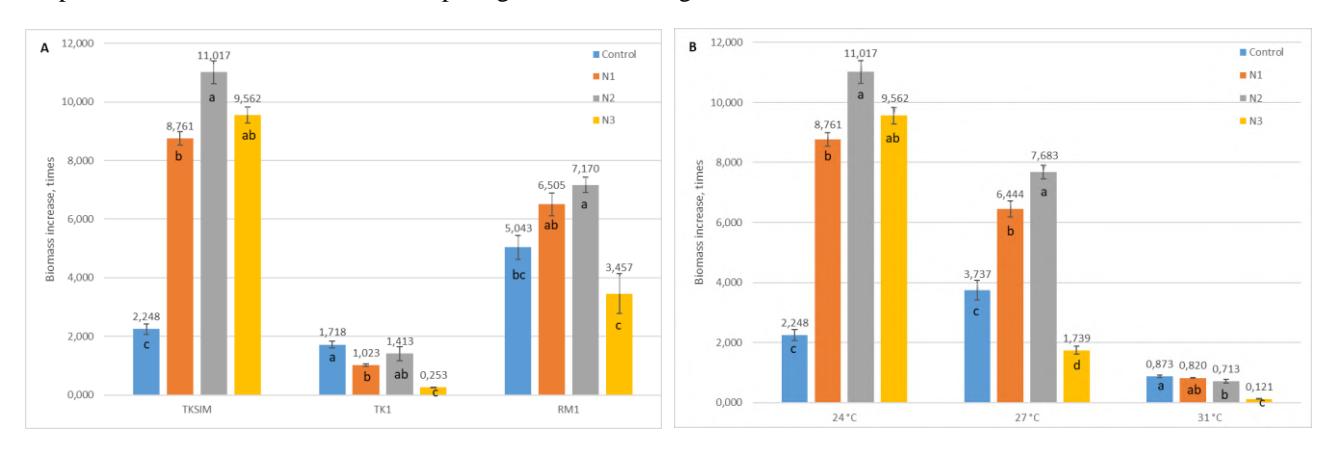
The results obtained show that the largest yield of transgenic tobacco calluses obtained in agarized RM1 medium at 27 °C, with an initial mean weight of one callus 400,0 ± 0,4 mg. The maximal biomass increases of the transgenic tobacco cell suspensions compared to the initial mass obtained by culturing them in liquid TKSIM medium at 24 °C temperature (Fig. 1). The control (untransformed) tobacco showed different biomass accumulation properties as compared to the transformants, as the control tobacco calluses had the highest mass increase in the agarized TKSIM medium and the cell suspensions in the liquid RM1 medium at 27 °C temperature. The results of the study suggest that the transformed N2 tobacco callus clone and the cell suspension initiated from it had the largest increase in biomass under the optimal conditions. The weight of the N2 callus clone increased as much as 5,057 ± 0,241 times, and the cell suspension - 11,017 ± 0,384 times comparing with initial weight.