
The ever increasing output energy of ultrafast lasers allows new advances in optical parametric broadband wavelength converter and amplifier system (OPCPA) development and high intensity fields physics experiments, such as high harmonic generation, THz radiation generation and acceleration of elementary particles.
One of the key features of ideal pump sources for high intensity OPCPA systems is high pulse energy. A classical approach to achieving high pulse energy is to use an Yb:KGW regenerative amplifier, which is limited to few mJ pulse energy. State of the art high energy lasers are usually constructed using thin disc or slab technologies based on amplification in ytterbium doped yttrium aluminum garnet (Yb:YAG). Recent advances on these technologies have shown that pulse energies as high as 0,7 J are achievable [1, 2]. Another promising new technology is coherent combination of laser pulses that has also allowed to reach few tens of mJ of energy [3]. However, these technologies rely on highly complex and expensive optical arrangements which are not always necessary when aiming for few tens of mJ energy [4].
Our approach to reaching pulse energies of about 10 mJ is by making use of hybrid laser technology, where we combine a fiber seed source and free space Yb:YAG amplifiers. This allows us to take advantage of reliability, scalability and compactness of fiber laser technology while retaining the ability to reach high pulse energies.
We demonstrate a 10 mJ laser system that is comprised of a high energy fiber seed source and two free space 2 pass Yb:YAG amplifier stages (fig. 1).
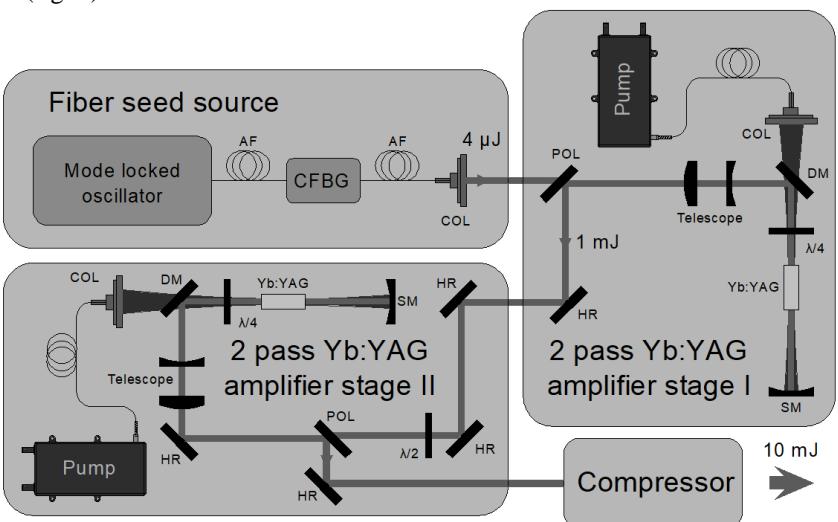
Parameters of the seed for the first Yb:YAG stage were determined by an all-fiber source. It consisted of a SESAM mode-locked fiber oscillator, dispersion matched chirped fiber Bragg grating (CFBG) pulse stretcher and two fiber amplifiers. The initial laser pulses, generated in the mode locked fiber oscillator were pre-amplified to a sufficient energy to undergo the spectral broadening in a passive fiber and then were stretched with CFBG to 240 ps pulse duration. Afterwards pulses were amplified to 4 μJ in two fiber amplifiers with pulse repetition rate reduced to 10 kHz before the final fiber amplifier in order to achieve high energy. The pulse repetition rate was further reduced to 20 Hz by an external free-space pulse picker and then the beam was directed to the first solid-state amplifier stage. The seed radiation was then amplified in a 2-pass Yb:YAG amplifier up to 1 mJ energy. The chirped pulse duration was reduced to ≈ 100 ps due to relatively narrow amplification bandwidth of Yb:YAG. The beam quality was close to ideal (M2 ≈ 1.03) after the amplification and the Fourier transform-limited pulse duration was ≈ 700 fs. The laser beam was further amplified at the second 2-pass Yb:YAG amplifier up to > 10 mJ energy and compressed down to ~1 ps using a conventional diffraction grating compressor. The further system characterization results will be presented at the conference.