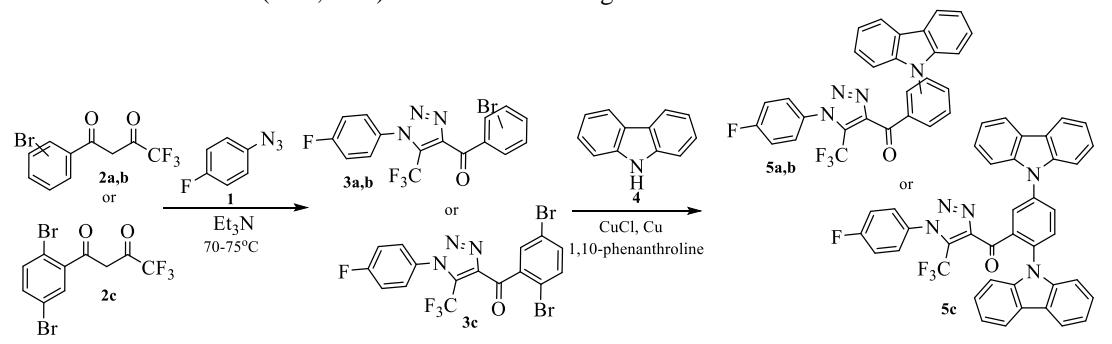
Our primary effort was to develop the way of molecular design and convenient synthesis of new compounds bearing 1H-1,2,3-triazoles as accepting fragments and exhibiting thermally activated delayed fluorescence (TADF). 4-Benzoyl-5-trifluoromethyl-1H-1,2,3-triazole was identified as suitable accepting unit for our goals. Decoration of triazole moiety with carbazole donors through ortho- and meta-positions (or both) of benzoyl fragment lead to donor-acceptor type compounds with through-space TADF effect. The developed synthetic pathway to such compounds was based on application of low-cost commercially available starting materials and simple synthetic protocols Synthesis of the target compounds was based on convenient Dimroth-type 1,2,3-triazole synthesis [1] and the following Ullmann-Goldberg C-N coupling [2].
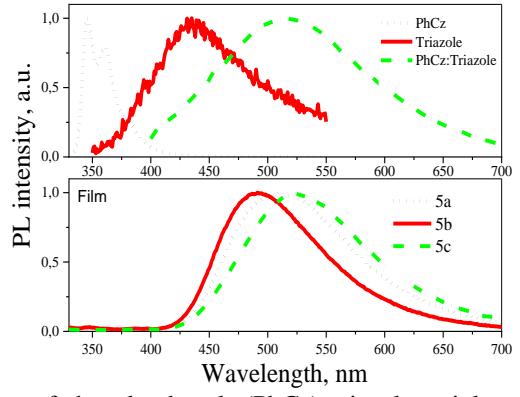
Due to the exciplex formation between covalently bonded electron-donating carbazole and 1,2,3-triazole-based electron-accepting moieties with small singlet-triplet splitting (0.07-0.13 eV), the compounds exhibit intersystem crossing-assisted bluish-green TADF. The compounds were characterized by high triplet energy levels ranging from 2.93 to 2.98 eV. The most efficient exciplex-type TADF was observed for orto-substituted carbazole–benzoyl-1H-1,2,3-triazole which was selected as a host for efficient solution processed white light-emitting diodes [3]. The best device exhibited the maximum power efficiency of 10.7 lm/W, current efficiency of 18.4 cd/A, and quantum efficiency of 7.1%. This device also showed the highest brightness exceeding 10 thousand cd/m². Usage of the exciplex-forming host allowed to achieve low turn-on voltage of 3.6 V. High quality white electroluminescence was obtained with the close to nature white colour coordinates of (0.31, 0.34) and colour rendering index of 92.