Excitation annihilation is a common phenomenon in molecular structures. It is often difficult to ensure experimental conditions that could prevent annihilation; therefore, it might often be necessary to account for annihilation while analyzing data.
Simple annihilation model can be described by rate equation Eq. 1:
$$ \frac{\mathrm{d}n}{\mathrm{d}t} = -\gamma n^2,\tag{1} $$here n(t) is the mean number of remaining excitations in the system at time t and $\gamma$ is the rate constant for annihilation. In this model, the size of molecular aggregate, excitation transfer rate across the aggregate, and initial population of excitations are considered to be very large. In order to include finite transfer rate, $\gamma$ must be considered as a function of time, which for one-dimensional systems at longer times can be approximated by a power law [1]. More precise statistical model accounts for the discrete number of excitations, but still considers the whole aggregate as a supermolecule, resulting in the system of Pauli Master equations [2].
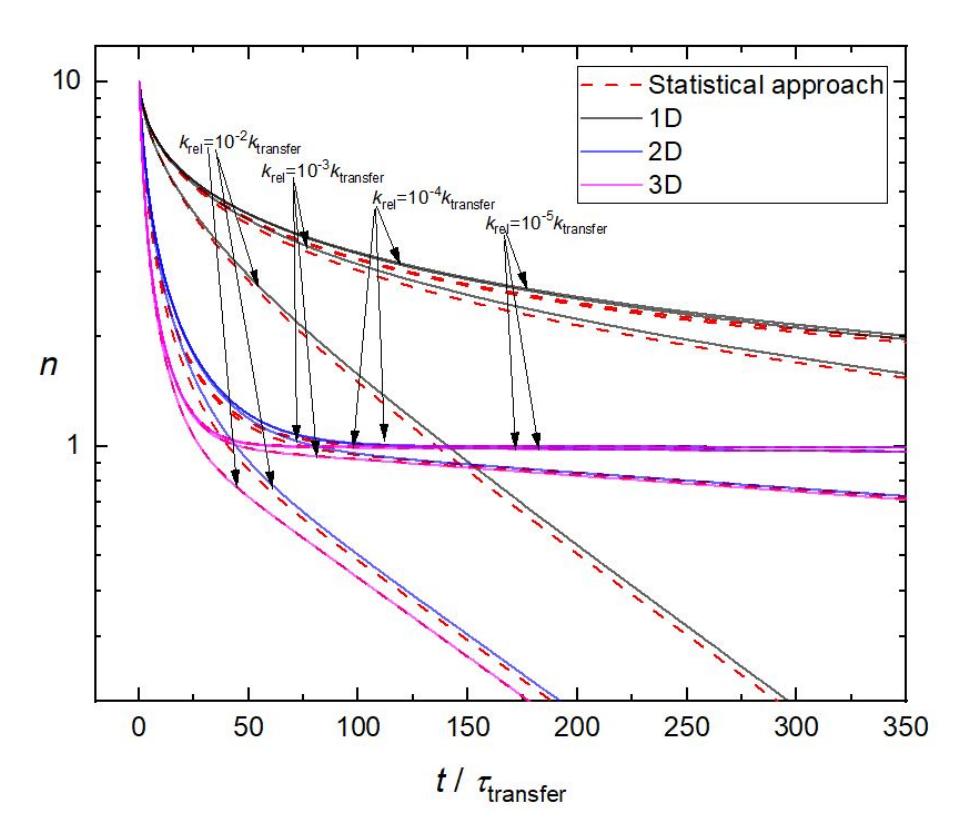
To account for both finite transfer rate and discrete number of excitations in annihilation model, we have chosen to use Monte Carlo method. The model is based on continuous time random walk. After sufficient number of lattices have been generated, the average kinetics of specific initial number of exitations is calculated. The average kinetics is later recalculated considering that initial distribution of excitations obeys a Poisson distribution.
The Monte Carlo kinetics were approximated using two different approaches: the statistical approach and the kinetic equation. For both approaches the same seven annihilation rate time dependences were used. We show that statistical approach works well for excitation dynamics, whereas the kinetic equation fails for most cases. While using the annihilation rate function that works the best with the statistical approach, we approximate the Monte Carlo kinetics (Fig. 1) and determine the universal set of annihilation rate parameters.