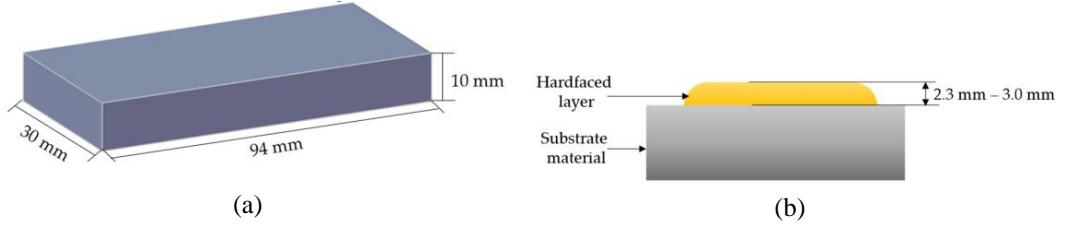
In this study, the technology of powder plasma transferred arc welding (PPTAW) was used to improve upon the wear resistance and hardness of mild steel, by deposition of hardfaced layers composed of Ni-based powders reinforced with tungsten carbide (WC) particles. Two Ni-based metal matrix composite (MMC) powders were used; PG, with a composition of NiSiB + 60wt% WC, and PE, with a composition of NiCrSiB + 45wt%WC. PPTAW process parameters - plasma gas flow rate (PGFR) and plasma transferred arc (PTA) current were varied in the preparation of the hardfaced layers onto the surface of the substrate mild steel, with eight (8) samples prepared. Schematic diagrams of the prepared samples with dimensions are shown in Fig. 1. The surface hardness of the prepared hardfaced layers was estimated to be in the range of 46.3 – 48 HRC for PG powder samples, and 52.7 – 58.3 HRC for PE powder samples. Microhardness of the Ni-based matrix was in the range of 573.3 – 893.0 HV, and the WC reinforcement had microhardness in the range of 2128.7 – 2436.3 HV. The relative abrasive wear resistance of the as-deposited layers was investigated against the performance of abrasive wear resistant steel, Hardox 400, which has an approximate nominal hardness of 400 HV.
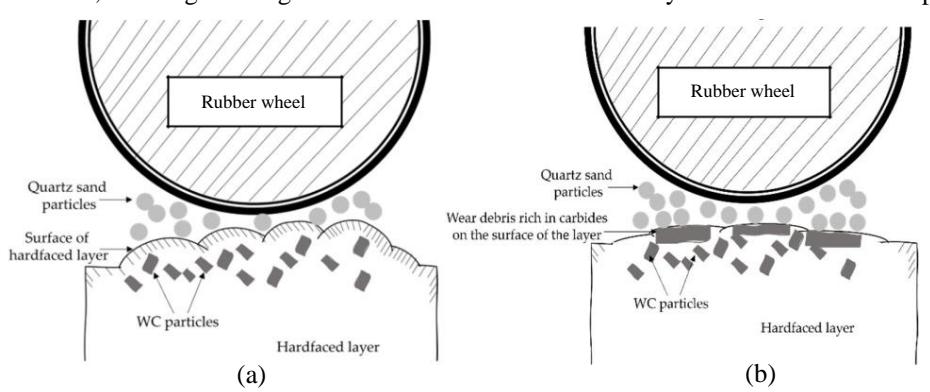
It was concluded from this study that the use of Cr as an alloying element enhanced the hardness and wear resistance. Increasing the PGFR increased the hardness and wear resistance of the layers, alongside an increase in the number of surface cracks. Increasing the PTA current reduced the wear resistance, but improved the hardness, alongside a reduction in the number of surface cracks. The wear mechanism is illustrated in Fig. 2.