
Chiral amine compounds are widely used as active pharmaceutical ingredients, agricultural chemicals, and other biologically active compounds [1]. Aminotransferases (AT) are enzymes that mediate the transfer of an amino group to a ketone acceptor. ATs have been already proven to be a promising catalyst in the synthesis of chiral amine compounds. The catalysis by ATs is performed under mild conditions, without the use of toxic metals and solvents, and has a higher stereo- and regio-selectivity compared to the organic synthesis [2]. However, the broad application of such enzymes is restricted by a limited number of the identified ATs.
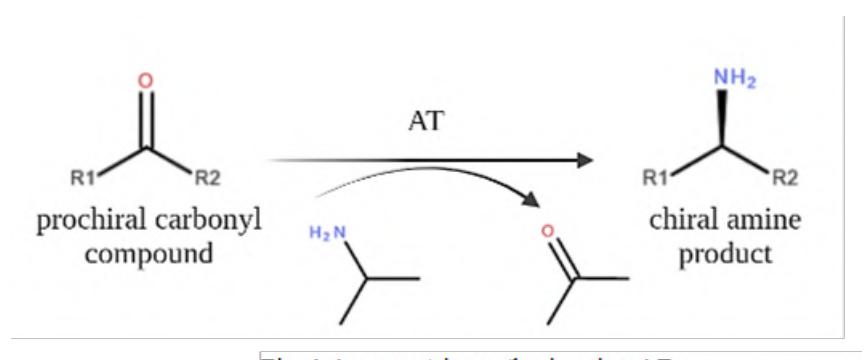
In this study, we searched for aminotransferases in the metagenomic DNA libraries using indol-3-ylmethylamine as a prochromogenic amino donor. We found and recombinantly expressed 18 different ATs. The experimental analysis revealed that the tested aminotransferases were active towards a wide variety of aromatic and aliphatic keto compounds and were capable of using isopropylamine as an amino donor (Fig. 1). In small-scale amination experiments, we were able to achieve a conversion of 95% for 2-acetylpyridine and 2-indanone using AT as a biocatalyst. Furthermore, some ATs showed activity towards monosaccharides and, therefore, could be employed for the synthesis of different aminopolyols – a class of products that are of particular interest as carbohydrate mimetics.
In summary, we successfully identified ATs active towards a wide scope of keto compounds. We showed ATs to be promising biocatalysts for chiral amine production.