Optical-parametric light generation is a unique way to obtain continuously tunable laser radiation in a wide spectral region. Relatively inexpensive and compact subnanosecond (100 ps - 1 ns) optical parametric generators (OPG) with broad wavelength tunability are needed for a variety of applications that do not require the high temporal resolution supplied by expensive and sophisticated ultrashort (<10 ps) laser systems, but nanosecond (>1 ns) time resolution is not sufficient. Such applications are spectroscopy, laser-induced fluorescence, detection of chemical materials, nonlinear microscopy and THz generation to name a few [1-3]. Development and the reduced cost of the micro-laser manufacturing technologies permits them to be used as a high energy pump source for subnanosecond OPGs. Such micro-laser pumped subnanosecond OPGs would allow the implementation of low-cost, compact, continuously tunable laser radiation sources suitable for the aforementioned applications, especially in near-infrared (NIR) and visible (VIS) spectral ranges where the demand is high. To date, no subnanosecond OPGs based on short (up to 2 cm in length) periodically poled (PP) crystals have been demonstrated that could also be continuously tunable over a wide spectral range. Extensive and detailed investigation of such OPGs is necessary in order to create a commercially attractive product.
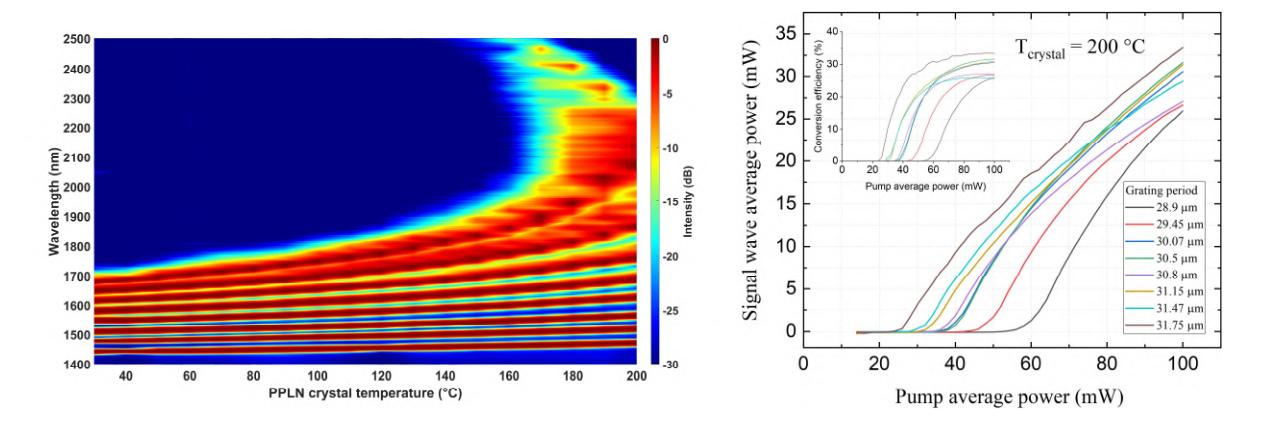
In this paper we investigate optical parametric generator based on periodically poled lithium niobate (PPLN) crystal pumped by subnanosecond pulses from a micro-laser. Pump source was a passively Q-switched Nd:YAG micro-laser that generated 520ps (FWHM) pulses at 1 kHz repetition rate with pulse energy up to 1 mJ. Pump light was focused into a relatively short 2 cm in length PPLN crystal doped with MgO and poled in 8 gratings with periods ranging from 28.9 - 31.75 μm. Continuous tuning of signal wave wavelength in 1440 - 2128 nm spectral range was achieved by varying the grating period and the temperature of PPLN, whereas internal conversion efficiency for the signal wave reached up to ~33% and depended on the grating period (Fig. 1). Experimentally measured spatial, temporal and spectral characteristics of the generated light are presented. Moreover, optical parametric amplification scheme using injection seeding technique is shown and discussed. The experimentally measured data is supplemented by the numerical simulations based on the three-wave interaction in a dispersive medium model. Good agreement with the theoretical results is obtained.