
A single-pulse shot of ultrashort laser irradiation enables the formation of complex microstructures on the surface of the thin gold film. The high elasticity of the metal allows to achieve both small and round-shaped, and high and narrow antenna-shaped structures. The driving force of the formation is the induced momentum normal to the surface at the heated or even molten layer of the noble metal and the fast solidification of it after structural change [1, 2].
This phenomenon achieved only by a single pulse leads to the formation of energy-dependent differently shaped microstructures [2]. Using energies at or a bit above the film modification threshold, the small hollow protrusions - microbumps are fabricated. The higher energies melt more material, and cone-like structures can be manufactured. Meanwhile, using energies a bit below the ablation threshold, the high and sub-wavelength width sharp nanoantennas are formed. The shape of microstructures depends not only on the energies used but also on the thickness of the layer. The bump structures remain quite similar, while the formation and shape of the antenna changes significantly. The produced microstructures are represented by a scanning electron microscope in Fig. 1.
It was investigated that the arrays of microbumps are exciting hybrid lattice plasmon polariton in VIS-NIR spectra with narrow resonant peak. Such polariton is excited due to interaction of diffracted from the grating light, which excites surface plasmon polariton, with surface lattice plasmons excited and amplified by interacting localized plasmons in periodic microstructures [3].
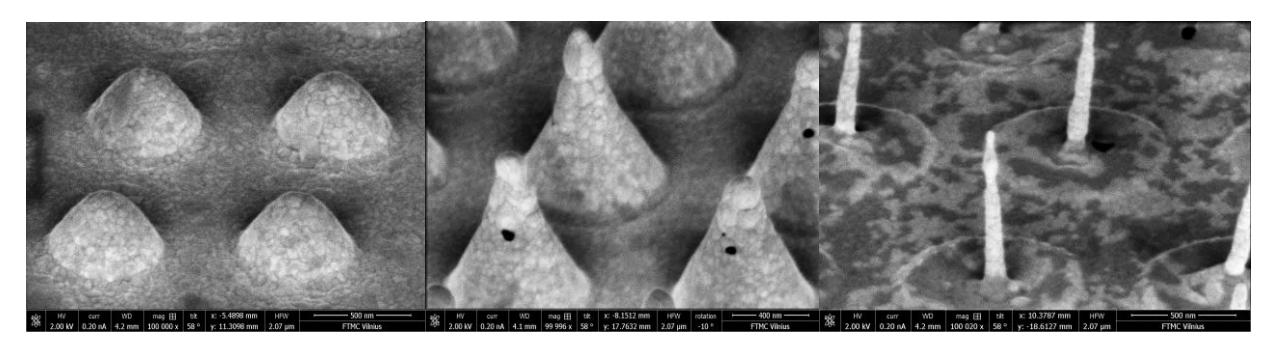
The periodic 3x3 mm2 arrays of such microstructures were fabricated using the direct laser writing method and the reflectance spectra were investigated with a spectrophotometer. All different structure arrays act as gratings exciting hybrid lattice plasmon polariton, only with a different response. The bumps show the best results, and the resonant peak is the deepest and narrowest. The resonance in the array of cones is wider and not so deep, while antennas have very shallow resonance spread in the spectra. While the response and place of the resonance are different for both orthogonal polarizations, the tendency of the results is the same for both of them.
The influence of the film thickness was also investigated, but only a slight difference in the resonance depth and width was observed.