
Opinion dynamics is a focal topic in sociophysics. Yet some authors note that there's a lack of comparison between voter model's theoretical results and empirical (experimental) data [1]. To overcome this issue some authors have suggested to include space (geography) in modelling opinion dynamics [1, 2]. To understand the implications of space to opinion dynamics, it's worth studying how empirical data can entail structures of opinion or such indicators.
This research analyzes changes in empirical compartmental distributions by changing the scale of empirical data. For this purpose empirical data from United Kingdom 2011 census have been chosen. Different demographic indicators of this data exhibit narrowing distributions as scale becomes less detailed. Yet it is unclear whether distributions stem from existing socio-demographic structures in United Kingdom or are of spatial nature.
A randomized spatial model is proposed to discover the nature of observed distributions. It takes compartments (distinct territorial units) from the most detailed scale of empirical data and joins them to replicate the number of compartments of a less detailed scale. Thus the compartments of the new scale are not consistent with geography but rather randomized. The said procedure is repeated for all non-first data scales. Then two diversity quantities are chosen for which relative changes in their value are calculated. These quantities are, namely, standard deviation and Theil index. Changes of these quantities for randomized spatial model are compared to the ones produced by empirical data. Overall, the procedure used in this model resemble what is well-known in statistics as null-hypothesis testing.
Results of randomized spatial model with the ones produced by empirical data are shown in Fig. 1. It is shown that relative changes of diversity indices in random model decline more rapidly than the ones of empirical data. Furthermore, we show that changes of proposed model follow the $N^{-1/2}$ power-law for standard deviation whilst for Theil index these correspond to $N^{-1}$. These results also demonstrate that the changes in selected demographic indicators are not of stochastic (random) nature as they decay noticeably slower.
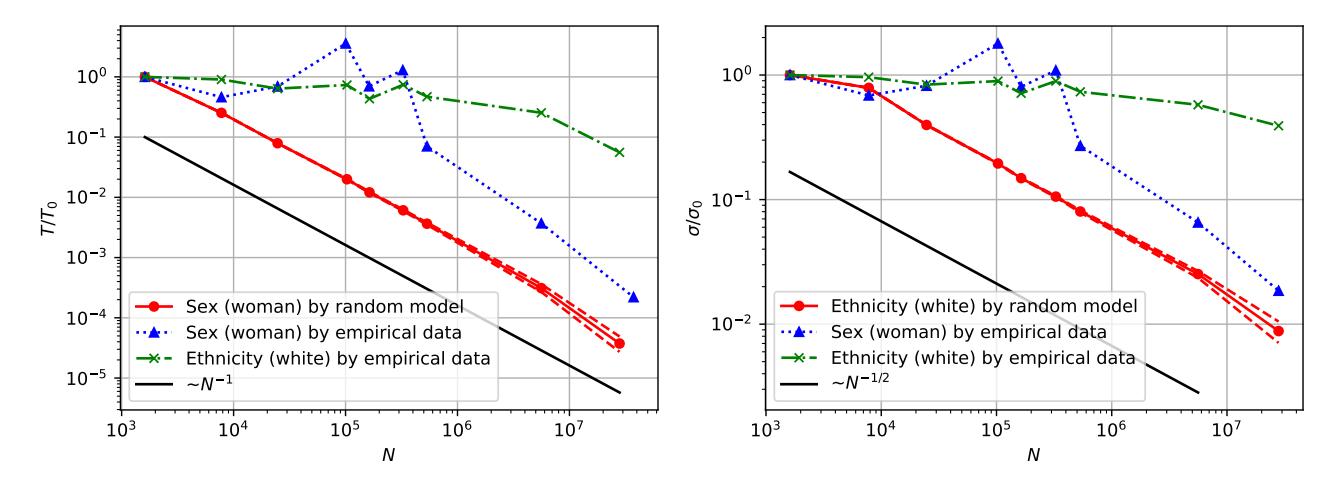
Among other results, it has also been noted that chosen diversity indices describe changes in different quality. Other two quantities (range and Gini coefficient) have also been tested for results with empirical data. Their relative changes are somewhat similar to the previously mentioned ones: range to Theil index and Gini coefficient to standard deviation.
In conclusion, the proposed randomized spatial model provides researchers with easy yet delicate measure to assess whether or not empirical data (or data generated by spatial models) is of stochastic nature. Different diversity and inequality quantities may be chosen for data evaluation as they are bound only to calculability via compartments. Lastly, the model is rather flexible so further adaptations can prove beneficial in testing other hypothesis.