
Many applications of metal nanoparticles are possible due to their interaction with light. Such interaction of the particles can be described as plasmonic effect (plasmonics) which holds huge interest in numerous investigations as the novel optical devices are based on such property, surface plasmon polaritons (SPPs) which are collective charge oscillations coupled to an external electromagnetic field that propagates along metal and a dielectric interface [1]. However, to successfully apply the advantages of it over lithography-based techniques, more investigations have to be done, especially with the material as silver.
In this investigation, SPPs effect is achieved with diffraction phenomena [2], where arranged nanoparticles of metal act as diffractive grating showing plasmonic resonances for incidence light. Here, when a plasmon is excited by a photon, the absence of photon results in a dip in reflected light at that specific angle for incident light. Such use of diffraction grating is based on theory as SPP waves cannot be excited by the incident light on a flat metal surface due to momentum mismatch as a free-space photon has less momentum (wavevector is smaller) than SPP.
During the investigation, periodic arrays of microbumps formation were produced on a thin 50 nm silver layer by laser direct writing technique (LDW) forming silver microbumps by a 1.1 nJ single laser pulse. Formed gratings were analyzed with a scanning electron microscope (SEM) and spectrophotometer.
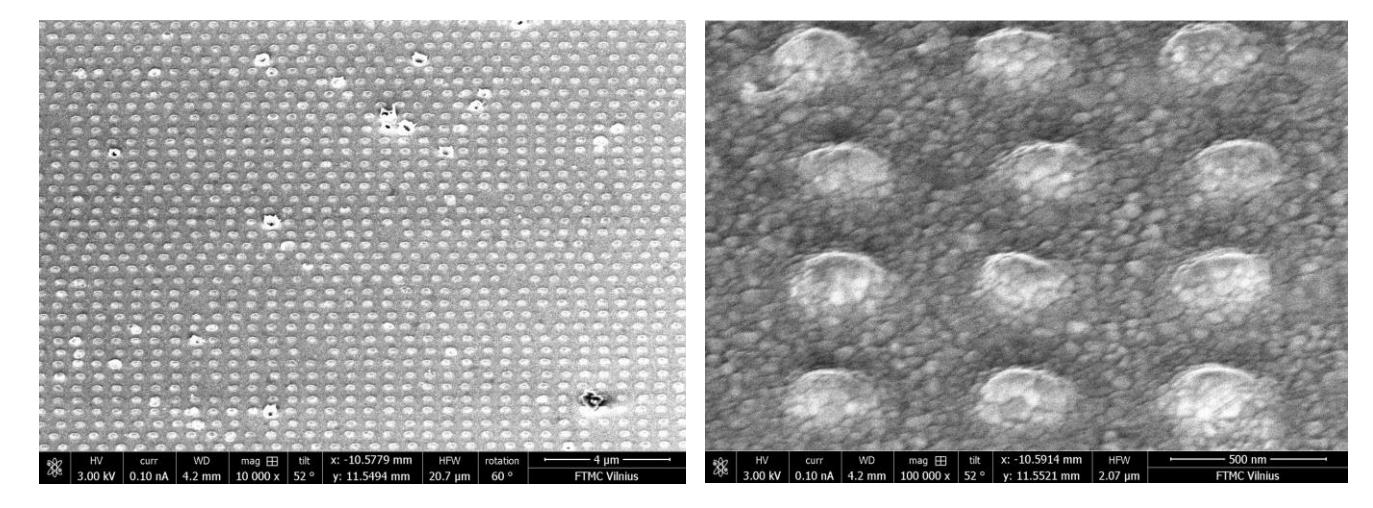
The results show that SPRs depend on the period of the fabricated arrays, light polarization, incident angle of light, and the sample orientation as the deepest and narrowest peaks were achieved parallelly to the incident light orientated sample and s-polarization. Such experimental results are in good agreement with theoretical estimations. Investigation on periodicity of arrays shows a strong dependency on it as for SPP peaks smaller period of arrays is desired.
The influence of the oxidation effect was also investigated, where after a month, resonance depth decreased almost twice. However, a solution for the oxidation effect was suggested.