
Nowadays, as humanity faces a problem of climate friendly and powerful fuel, research in this field becomes more important than ever before. While electrical engines are one of the options, in many cases the amount of power produced by them is insufficient. Another good option is hydrogen based fuel. Combined with oxygen it burns, producing energy while leaving water as a product of this reaction. However, scientific understanding and predictive capabilities required for safe and efficient exploitation of hydrogen for fuel is still lacking.
To perform application-relevant simulations of complex turbulent hydrogen combustion, various simplifications are employed. One of them is omitting detailed chemistry modelling and approximating required data using other methods. In our CFD simulations we substitute chemistry model with parametric estimation of laminar burning velocity (LBV). Up to now, we have been using internationally established correlations of LBV as a function of mixture equivalence ratio, temperature and pressure. However, these correlations lack accuracy in the whole domain of required conditions, therefore, in this paper we investigate the behavior of hydrogen flame in dry air by using various machine learning algorithms in order to predict LBV. Our aim is to produce an experimental data (from literature) based LBV model which is both more accurate than established correlations and sufficiently fast to be of use for CFD simulations. Created model will be implemented in our turbulent combustion CFD solver flameFoam [1], where it will be available as an option to estimate LBV required for the simulations.
In one previous work [2] we created an artificial neural network (ANN) which managed to explain approximately 98 % of data points, however that model was too slow to be used in CFD calculations. To achieve faster estimation speeds, large variety of algorithms were tested. This led to a new ANN model with reduced number of weights with a prediction speed faster by around 30 times than original ANN model, with a mean absolute error equal to 6.094699 cm/s and R-Squared value of 0.997.
Other estimation methods were also tested for comparison - support vector machines (SVM), random forest (RF), k-nearest neighbor (kNN) and multivariate adaptive regression splines (MARS). The ANN model clearly showed better results (Fig. 1.) than other tested models of this study. Most likely in 2nd place would be Support Vector Machines (SVM), which after extra transformation to turn negative predictions to 0 gives a mean absolute error equal to 23.37 cm/s.
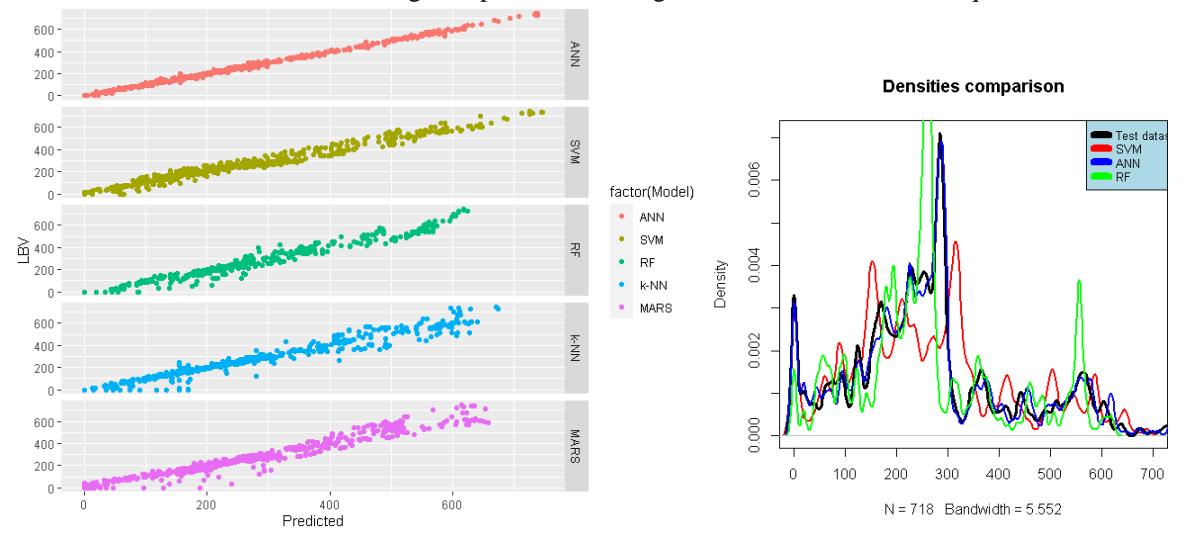
Overall, all models worked well compared with models founded in literature. This could be possible most likely for a few reasons:
1. Training data was prepared with most of the noise removed to make models more reliable.
2. Training was done using large amount of data (over 2000 data points), collected from literature.
A faster and accurate ANN model of hydrogen LBV was created for dry air and varying values of mixture equivalence ratio, temperature and pressure. Its accuracy is shown to be better than other tested methods. The work is being continued by implementing developed model into flameFoam CFD solver for validation simulations.