
One of the ways to improve the beam's spatial quality is by applying a spatial filtering mechanism onto the resonator system. Classical laser systems use a confocal arrangement of lenses and a membrane stationed between them to filter the beam. Such a system is extremely necessary if the pump power is highly increased. However, small compact micro-laser, as well as semiconductor devices, acquire new means of filtering for improvement of the beam's spatial quality, which is realized through implementing sub-wavelength periodic waveguide or photonic crystal systems either as low-pass transmitting filters or as reflectors [1].
Photonic crystals possess unique abilities to guide, transmit and reflect light, which entirely depends on the periodicity and aperiodicity of the device's geometrical layout (i.e. its lattice) as well as its modulation of refractive index. Various numerical models of such devices are being made and analyzed, especially the speedy Rigorous Coupled Wave Analysis (RCWA) [2], which is a semi-analytical method that numerically solves Maxwell's equations via Fourier expansion of the electric, magnetic fields, as well as the dielectric permittivity itself. It is used to primarily calculate transmittance and reflection of periodic waveguides that consist of arbitrary geometry. With the implementation of a global optimization algorithm, the geometrical parameters, as well as the distribution of refractive index in the system of periodic waveguides, can be optimized to achieve desired filtering effect.
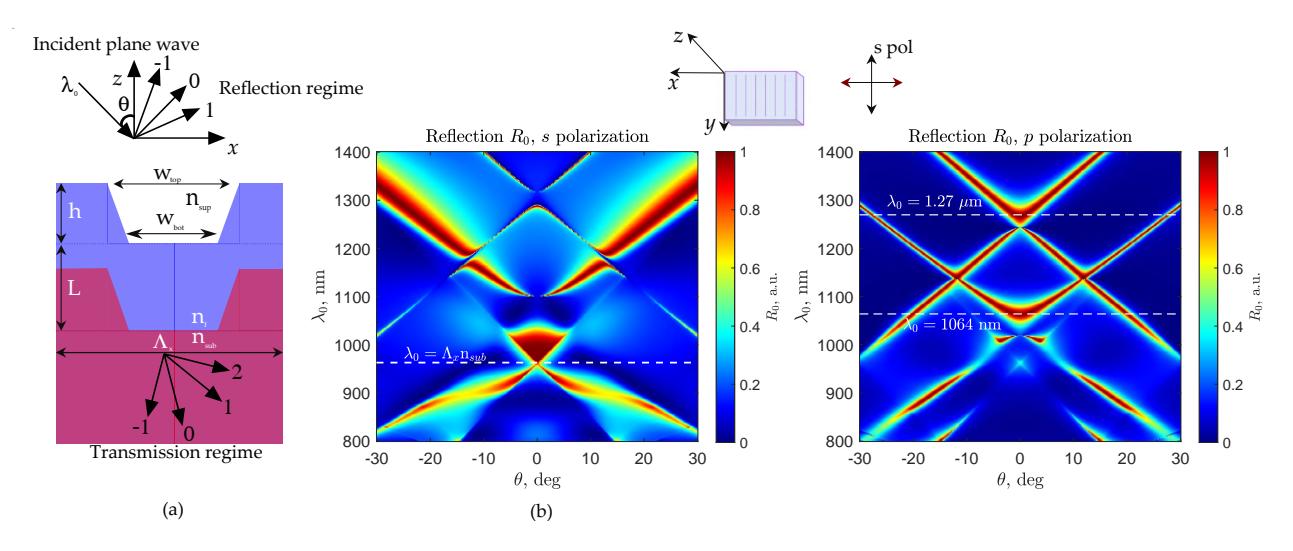
This work is dedicated to exploiting bound edge field modes within the device for spatial filtering. Such modes are leaky towards the substrate of the modulated waveguide. In the angular domain, a sharp transition from the zeroth-order reflection to the first transmission order is observed at the particular wavelength. Such an effect is allocated in the wavelength domain where the Rayleigh anomaly occurs [3], which can be interpreted as the energy redistribution between the diffraction orders when one of them becomes evanescent. By realizing this effect, filtering via reflection is obtained for a continuous range of wavelengths instead of a single one. In this work the theoretical concept is proposed. In the following, resonant reflections take place because of their localization within the film (inside a waveguide) or outside of it because of different arrangements of field modes in respect to energy within the asymmetrical quantum potential well.