Terahertz (THz) frequency electronics is one of the most developing fields of electronics. Terahertz waves fill the frequency range from the loosely defined beginning at 100 GHz up to 10 THz. The expansion of electronics into the THz frequency range is highly regarded nowadays due to the faster data communication and the perspective applicability in many other areas [1]. For example, this frequency range of electromagnetic radiation can be used in security systems - in airports to search for explosives, in medicine to detect cancer cells [1]. Both the good penetration through various dielectric materials as well as non-ionizing energies of THz photons make the radiation in the THz frequency range safe for medical applications [2].
There are different approaches to generate THz radiation using the concepts of the electronic. For example, nonlinearity in the electric circuit can be exploited for frequency multiplication, or the amplifier with positive feedback can be used to create the oscillator. Depending on the nature of amplification and the peculiarities of implementation, various oscillators exist. Whereas the methods of integrated electronics allow the implementation of many different types of oscillators, one architecture – a so-called Colpitts oscillator, gained high popularity for the fabrication of voltage-controlled oscillators for the THz frequency range. The Colpitts oscillator scheme can be transformed into a differential scheme consisting of two transistors and an LC resonant circuit [3]. The differential circuit implementation has several advantages: without increasing the size of the transistors, it allows to add on the power of two oscillators; and it provides a virtual ground along the symmetry axis, which can be used to bias the oscillators [3]. Furthermore, the intrinsic nonlinearity of the employed transistor (either field-effect or a bipolar) allows the efficient frequency multiplication and generation at higher harmonics. This work is therefore devoted to investigations of those higher harmonics.
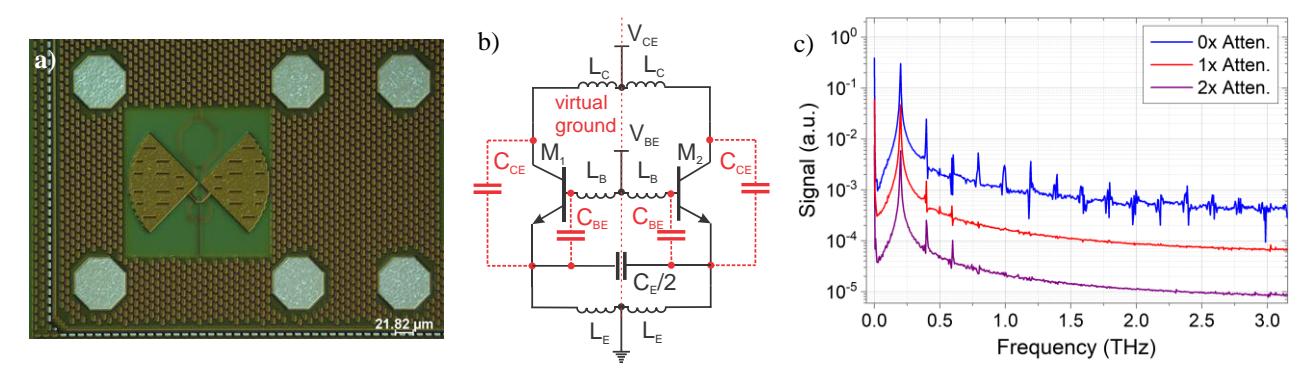
The device in this study has been implemented in a 130 nm BiCMOS technology with Si/Ge bipolar transistors using a Colpitts architecture (Fig. 1a and 1b). It delivers the maximum power of 500 µW at the first harmonic at 200 GHz. The spectral content of the emission was investigated with a Michelson-type interferometer with a broad-band detector (Golay cell). Fig. 1c (curve 0x Atten.) presents the direct analysis (the amplitude of Fourier transformed autocorrelation signal) of the emitted spectrum with many higher harmonics. The majority of these higher-harmonics are believed to be caused by the reflections in the interferometer, i.e., they are the numerical artifacts of the analysis due to the influence of the back-reflected radiation on the emission strength of the source. Therefore, we employed attenuators that decrease the emitted power as well as minimize the back-coupling by reflections. The results obtained with one and two additional attenuators presented in Fig. 1c support the abovementioned hypothesis. Yet, even two attenuators did not completely suppress the harmonics, leaving the second and third at 396 GHz and 597 GHz. However, to be certain about the origin of spectral peaks at higher harmonics, it is necessary to carry out an additional experiment with resonant detectors.