
Chewable gel tablets are similar to gummies, they have a gel base - usually gelatin, pectin or agar agar. This pharmaceutical form is prepared by using silicones, plastic or metal forms, and is not compressed by tablet machine punches as simple tablets [1-3]. Sweeteners (cane or beet sugar, glucose syrup, maltitol) are usually used [4,5]. Tablets, which have a lower sugar content, lose their texture properties quicker, so excipients are needed to solve this problem. One of them is glycerol, it protects tablets from sugar crystallization on their top and saves their physical properties. It does not let the gel tablets to harden and lose their elasticity [6]. The aim of this study was to manufacture chewable gel tablets and evaluate their properties.
Chewable gel tablets were prepared using by silicone forms, and their variation of mass, firmness, hardness, stickiness and springiness were evaluated by a texture analyzer. The two samples of gel tablets' composition were manufactured (the optimal composition of the gel tablets was selected from previous studies). Chewable gel tablets base was made from gelatin and water (1:2) or gelatin, water and glycerol (1:1:1). The amount of base was 27%, it was melted, and thyme-sugar syrup (68.5%) and thyme extract (2.5%) were added. A citric acid solution (2%) as a preservative was added.
The same silicone form was used to prepare gel tablets but the mass was different – tablets with glycerol were 3.65±0.11 g and without glycerol – 3.57±0.05 g ($p$>0.05). After one month (tablets were kept at room temperature), the mass variation was statistically significant: tablets with glycerol were 3.51±0.12 g, without – 2.61±0.03 g. A chewable gel tablets example is presented in Figure 1, and clear changes in texture are visible. Tablet A contains no glycerol, and sugar crystals are seen on the top, moreover, this tablet has cracks.
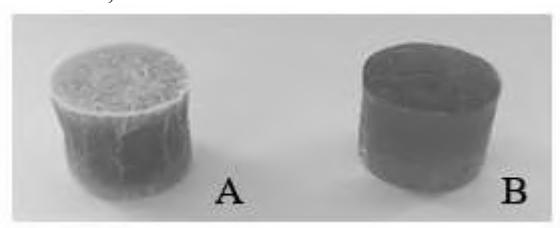
Comparing other parameters, the differences between different composition of freshly made tablets were not detected, but after one-month the differences were significant. Tablets without glycerol had over 3 times higher firmness and 4 times hardness, their springiness was 39% lower and they were not sticky.
The study found an important effect of glycerol on gel tablets. It helps to maintain the proper properties of chewable gel tablets when they contain a reduced amount of sugar and are kept in an open box at room temperature.