
In the last twenty years, organic electronics have been rapidly developed and it is expected to replace inorganic semiconductors in a number of uses in the near future [1]. Organic photovoltaics, organic light-emitting diodes, and organic thin-film transistors are highly advanced and already available commercially. Recently, organic electrochemical transistors (OECTs) are being researched and promise us breakthroughs in flexible printed sensors, electronic skin, OECTs based logic circuits, and implantable sensors [2, 3]. An OECT consists of an organic semiconductor film that is in contact with an electrolyte, in which the gate electrode is immersed. Applying a potential to the gate electrode can make semiconductor film more or less conductive by reducing or oxidizing it (doping/de-doping). Because of that, OECTs can be used in sensor signal amplification and ion-to-electron transduction. Organic semiconductor films used in OECTs are often based on conductive polymers, mostly poly(3,4-ethylenedioxythiophene) polystyrene sulfonate (PEDOT:PSS).
Even though developed PEDOT:PSS-based OECTs (Fig.1. (a)) achieve excellent performance with on-off ratios of 105, a threshold voltage of 200 mV, and a sub-threshold swing of 61 mV dec-1, however, OECTs have to be reliable to use it in circuits [4]. It is essential to have transistors with stable and reproducible parameters: threshold voltage, on-off current, subthreshold slope, and transconductance. These values tend to differ a lot from sample to sample and because of that, it is crucial to understand the underlying problem in the fabrication process. This can be achieved by quantifying the variation of parameters and, in a second step, improving the fabrication process.
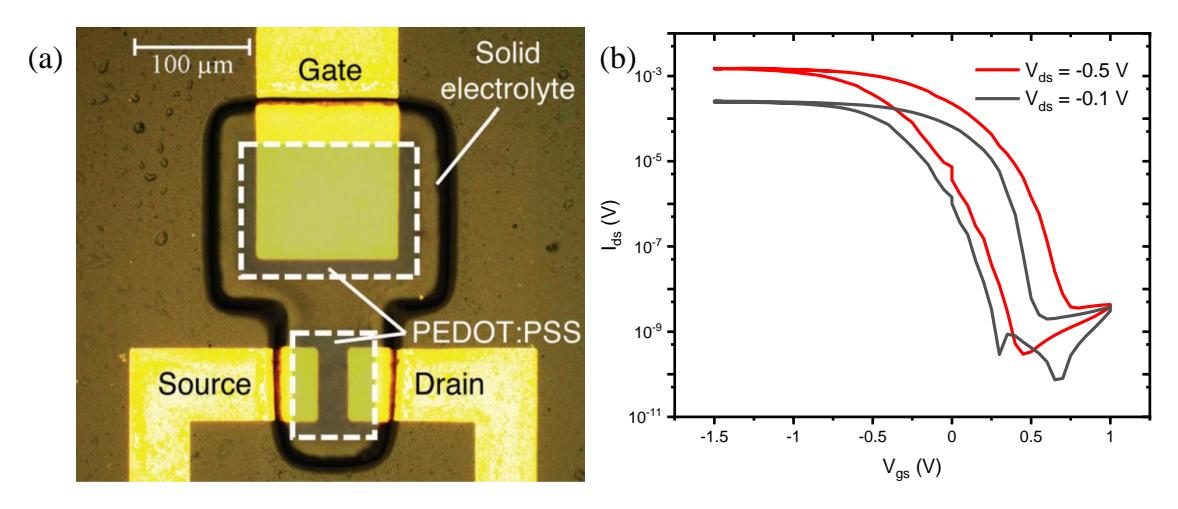
Discussed OECTs were developed in advance by co-workers and can be fabricated using well established 3-step lithography. We constructed solid-state OECTs with various geometrical parameters and collected data for statistical analysis by measuring transfer characteristics (Fig.1. (b)) of an OECTs using different drain voltages ($V_{ds} = -0.1 V$; - 0.5 V; - 1 V; - 1.5 V). Mean values and standard deviation were calculated, Grubs and normality tests were used to describe the data. Using the collected data, we adjusted the fabrication process to lower standard distribution and increase the reproducibility of PEDOT:PSS based OECTs.