
Antioxidant packaging releasing antioxidants to prevent food oxidation is one of the main packaging technologies. Compared to synthetic antioxidants, natural antioxidants such as herbs and spices are of great interest because of their safety and health characteristics [1]. Our previous work has shown that incorporation of essential oils in biopolymers can secure their high antioxidant properties, and such active materials potentially could be applied in food packaging [2].
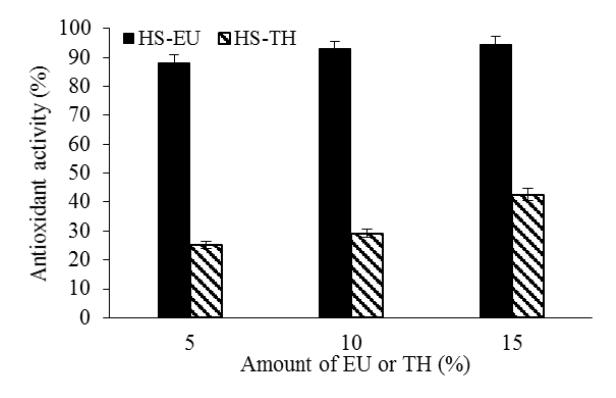
In this study, eugenol (EU) and thyme essential (TH) oils were immobilized in hydrophobically modified starch (HS) and their potential as antioxidant packaging materials was investigated. Emulsions containing 20 % of HS and 5, 10 or 15 % of essential oil were prepared, and droplet size, zeta potential, viscosity and antioxidant activity characteristics were determined (see Table 1 and Fig. 1).
| Emulsion | Particle size of emulsion droplets (nm) | Zeta potential (mV) | Viscosity (mPa·s) |
|---|---|---|---|
| HS-EU(5%) | 326 ± 4 | -10.5 ± 0.5 | 32.3 ± 1.6 |
| HS-EU(10%) | 1049 ± 31 | -10.6 ± 0.3 | 41.9 ± 2.1 |
| HS-EU(15%) | 1307 ± 24 | -4.6 ± 1.3 | 49.4 ± 2.5 |
| HS-TH(5%) | 1040 ± 18 | -13.6 ± 1.2 | 30.1 ± 1.5 |
| HS-TH(10%) | 1320 ± 24 | -7.2 ± 1.0 | 33.8 ± 1.7 |
| HS-TH(15%) | 1333 ± 2 | -5.7 ± 0.9 | 50.1 ± 2.5 |
It was determined, that the particle size of emulsion droplets depended on the type of essential oil and its amount in composition. The particle size was increasing with increasing concentration of essential oil in both types of emulsion. The emulsions with smallest droplets of about 362 nm diameter were obtained when using 5 % of eugenol. Moreover, particles were negatively charged. It was found that the viscosity of both types of emulsion was increasing with increasing amount of essential oil in the composition. The antioxidant activity (AA) of emulsions containing eugenol was higher (88-94%) compared to emulsions with thyme essential oil (25-43 %). In addition, the stability of the emulsions and demulsification process were assessed when keeping the samples for up to 10 days at 20 °C and 5 °C temperature. It was determined that 5°C temperature was more favorable for storing of emulsions.
For active coatings preparations HS-EU(15 %) and HS-TH(15%) emulsions were cast on paper by using a coating equipment. It was found that the coating containing eugenol had the significant higher AA (90%) comparing to coating with thyme essential oil (AA=40 %). Consequently, hydrophobically modified starch can be successfully used as a matrix for immobilization of natural antioxidants such as eugenol and thyme essential oils and these compositions have potential to be used in antioxidant packaging application.