Relaxor ferroelectrics can be used in diverse applications, for example, energy storage [1]. Relaxor additives are added to ferroelectric solid solutions to alter its characteristics. However, commonly used lead titanate is allowed to be utilized only in limited applications due to health concerns raised by the European Parliament and the Council on RoHS [2]. Because of these legislative enforcements, demand for lead-free analogues appeared and they were heavily studied in previous decade. One of these materials, x(Bi(Zn2/3Nb1/3)O3)-(1-x)BaTiO3 has received interest as a high-capacity relaxor dielectric material. These ceramics have different composition regimes depending on x concentration, such as: BaTiO3-like ferroelectric (0 < x < 3.0%), relaxor ferroelectric (4.0% < x < 5.0%), low loss relaxor dielectric (x > 10.0%) [3].
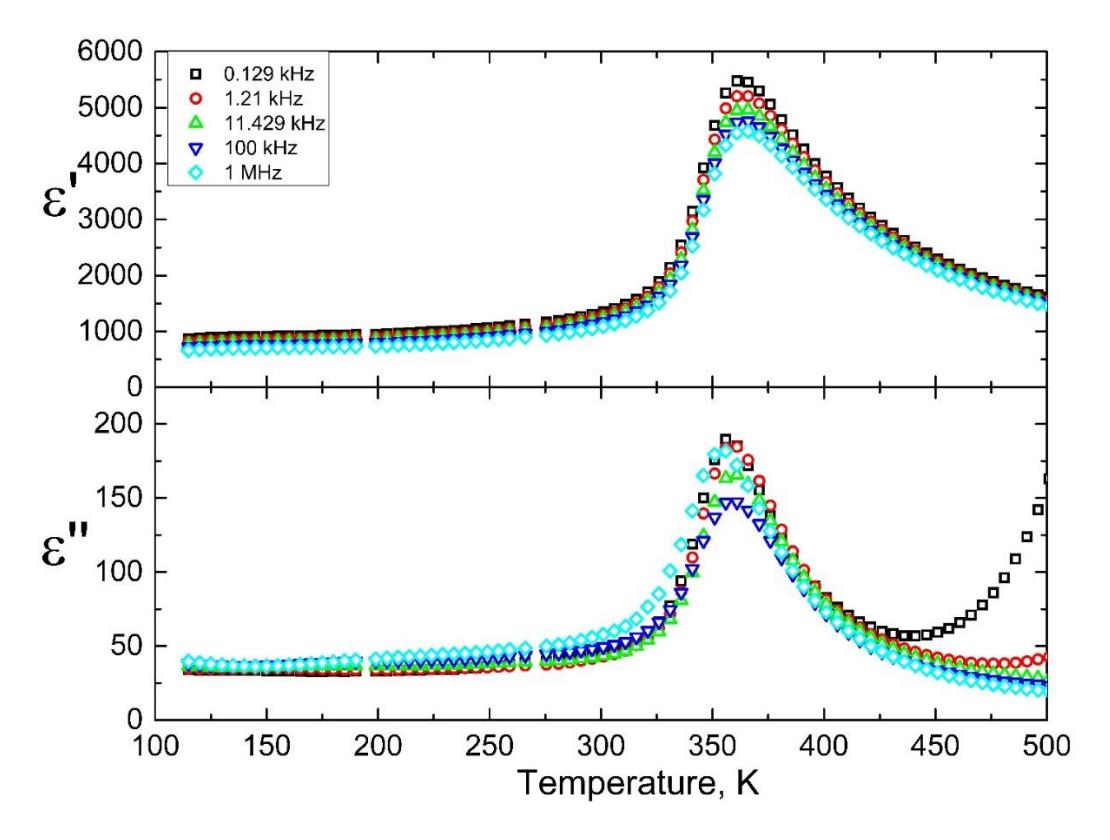
In the present work the dielectric properties of four x(Bi(Zn2/3Nb1/3)O3)-(1-x)BaTiO3 ceramics in 129Hz-1GHz frequency range and 150-500K temperature range are analyzed. Conductive silver paste electrodes were applied on and gradually annealed up to 773K. The measurements of dielectric permittivity were performed during cooling cycle at close to 1K/min temperature decline rate. Fig. 1 shows frequency and temperature dependency of real and complex parts of dielectric permittivity. The peak of real part of dielectric permittivity (at around T ≈ 361K) corresponds to the temperature where polar clusters become so large that they stop following the applied field [4]. Whereas, the peak of the complex part at temperature T ≈ 356K indicates that dielectric dispersion reached its maximum.
Fig. 1. shows discussed dependency in 129Hz-1MHz frequency range. However, presented results will be up to 1GHz frequency.