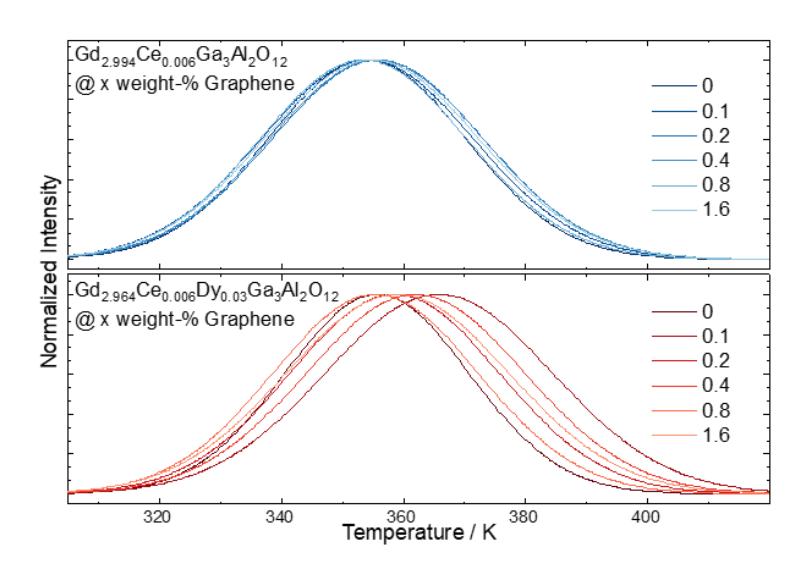
Persistent luminescence is a phenomenon in which material is emitting light for a long time after ceasing the irradiation. The long-time luminescence fading is the effect of releasing the electrons from the deeper traps with the help of thermal energy [1]. The energy needed for releasing the traps is an important factor that has a big impact on the intensity and time of persistent luminescence. Therefore many experiments are made to prepare materials with the appropriate energy gap end electronic structure, where defects/traps are located close conduction band (CB) and energy of room temperature is sufficient to transfer the electron from the trap through CB to excited state of luminescent centre [2]. The work was focus on check if the addition of graphene flakes will have an influence on the thermal conductivity of the ceramics and in consequence on the persistent luminescence properties. It was checked whether the changed thermal conductivity has an impact on the release of electrons from shallow and deep traps. Better thermal conductivity should reduce the amount of energy needed to release carriers from energy traps and thus improve the properties of persistent luminescence. To verify this assumption, ceramics showing persistent luminescence and composites containing an admixture of graphene flakes were prepared and characterized. For all materials, their structure, morphology, thermal conductivity, thermoluminescence, and spectroscopic properties were examined. Based on the obtained results, the mechanism of persistent luminescence was constructed, taking into account the influence of the graphene flakes addition and its relationship with the thermal conductivity of composites.