
Calcium phosphates (CPs) are inorganic materials widely used in bone regeneration due to their structural and compositional similarity to natural bone [1]. Compositional and structural variety of CPs leads to their different physicochemical, mechanical and biological properties, which allows to apply these materials in medicine in various forms from cements to ceramics and coatings. One of the parameters, based on which CPs can be classified, is Ca/P ratio in these materials. Some CPs phases can be prepared using precipitation reactions from aqueous solutions, but some of them can be prepared only employing a thermal treatment [2]. The present work is inspired by the recent study by Döbelin et al. [3] who demonstrated the change of surface phase composition of different CPs pellets after annealing. The authors showed that thermal treatment leads to the selective evaporation of phosphates from the surface layer and the formation of secondary CPs phases with higher Ca-to-P ratio and even CaO. The thickness and composition of the phosphate-depleted surface layer was found to be dependent on the annealing parameters, but the aforementioned work studied the effects of annealing in air atmosphere only. The main aim of our study was to expand these results and to investigate the influence of different annealing conditions on phase transformations and composition of bulk materials.
In the present work, synthetic brushite (CaHPO4·2H2O) with Ca-to-P ratio 1:1 was taken as a starting material and annealed at 1200 °C for different periods of time under three different conditions: in a static air atmosphere, in nitrogen flow and in vacuum. The purity and phase composition of powders were evaluated by powder X-ray diffraction (XRD) and Fourier-transform infrared spectroscopy (FTIR). Phase quantities were determined by Rietveld refinement using the FullProf suite. Scanning electron microscopy (SEM) was used for the characterization of morphological features of synthesized products.
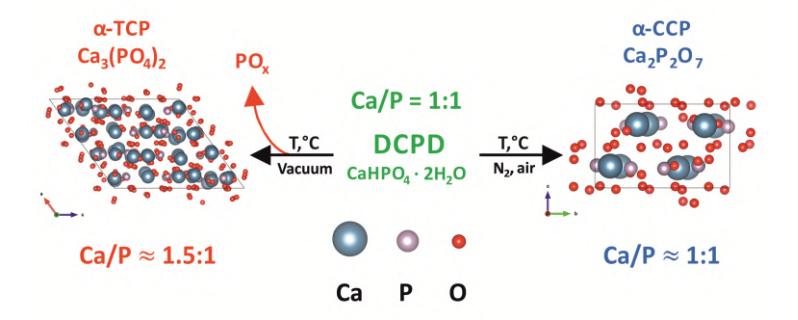
It was demonstrated that the phase composition and Ca/P ratio in the final product highly depend on the annealing conditions due to the evaporation of phosphate species. Annealing in air did not result in significant changes in Ca/P ratio, α-Ca2P2O7 was obtained as a major phase with a minor α-Ca3(PO4)2 phase. Similar phase composition was obtained after the heat treatment in nitrogen flow. The most drastic changes in stoichiometry and phase composition were obtained after annealing in vacuum. The resulting powders consisted mostly of α-Ca3(PO4)2 with a negligible amount of α-Ca2P2O7 as a secondary phase, which suggests a remarkable change in Ca/P ratio up to approximately 1.5:1. The evaporation of phosphate species from the bulk powders occurred exclusively from α-Ca2P2O7, no obvious degradation of α-Ca3(PO4)2 was observed under the selected conditions.