
Laser micro-fabrication of transparent media with ultrafast laser pulses has seen substantial interest in scientific and industrial communities, as the demand for rapid cutting, dicing, ablation is skyrocketing. The Bessel-Gaussian beam is becoming increasingly popular in this field due to its elongated focal zone that reduced the processing complexity by eliminating the need to translate Gaussian beam over the full depth of the material. The use of Bessel-Gaussian beam in transparent material cutting does not compromise surface quality, while the processing speed is increased dramatically. It is shown that it is possible to cut various glasses of up to a few millimetres thickness [1].
The most common Bessel-Gaussian beam shaping element is an axicon – a glass cone with a sharp tip. However, any deviations from the perfect shape of the element - any irregularities of its surface and especially a rounded tip greatly reduces the quality of the generated beam by inducing unwanted axial intensity modulations along the focal zone [2]. Alternative beam shaping elements are used to generate more complex beam patterns or to improve overall beam quality: diffractive optical elements, spatial light modulators, complex sub-wavelength metasurfaces [3,4,5]. Using these alternative options, it is possible to generate beams that have been modified for higher efficiency micro-fabrication while still exhibiting Bessel-Gaussian beam propagation characteristics.
In our research we use beam shaping elements that are created by inscribing birefringent nanogratings in bulk fused silica [6]. With direct laser written nanogratings we can control retardance and orientation of them over the full width of the element enabling manufacture of custom flat optical elements, known as geometric phase elements (GPEs). GPEs can be used for many purposes, as their damage threshold is very high, close to the material damage threshold they are made of. In our scope of the research, we know that it is possible to form new Bessel-Gaussian beam intensity distribution, for example, a beam with an elliptical central peak (Fig. 1, b) [7]. The elongation of the beam central peak can be used to initiate controllable and oriented microfractures in transparent material, i.e. stealth dicing.
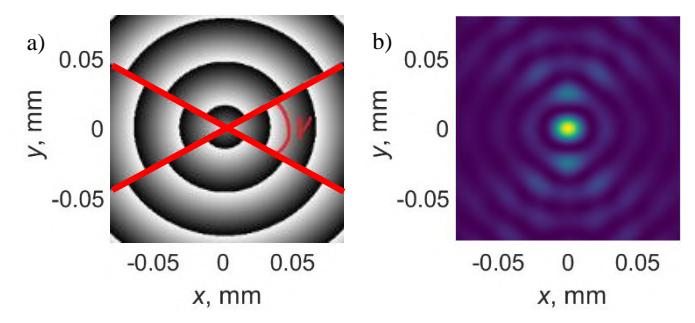
In this work we use numerical simulation to investigate Bessel-Gaussian beam intensity distribution. We divide the axicon phase and induce a phase shift between them which in turn can form a necessary modification to Bessel beam intensity distribution (Fig. 1, a). We scan the parameter space to find optimal modified axicon phase to generate elongated peak with relatively good contrast. This phase distribution will be used to manufacture GPE and after confirmation of the beam transformation quality, the element will be used for transparent material dicing.